
Silicone RFID laundry tags are the option we recommend when a textile has to survive both an industrial wash tunnel and a chemical load that would dissolve a printed label. This guide covers what the tag is actually made of, the specifications that decide whether a project works, how the encapsulation process is run, the parameters you can customize, and where silicone beats textile or PPS tags — and where it does not. If you are specifying UHF laundry tags for a hotel group, a hospital laundry, or a workwear rental fleet, this is the information we walk customers through before quoting.
In this article
- What Are Silicone RFID Laundry Tags?
- Inside the Tag: Antenna, Chip, and Why Silicone
- Specifications That Actually Decide the Project
- How They Are Made: From Inlay to Encapsulated Tag
- Customization Parameters
- Five Attachment Methods and How to Choose
- Industry Applications and Real Scenarios
- Running a Pilot: A 90-Day Plan
- Silicone vs. Textile vs. PPS Laundry Tags
- FAQ
1. What Are Silicone RFID Laundry Tags?
A silicone RFID laundry tag is a passive UHF RFID inlay — antenna plus chip — sealed inside a molded silicone rubber shell. The inlay carries a unique Electronic Product Code; the silicone does the job that fabric, paper, or epoxy cannot: it keeps wash liquor, detergent, caustic soda, bleach, and mechanical tumbling away from the chip for hundreds of cycles, while staying soft enough to sit inside a hem or a pocket without damaging the textile.
The format you will see most often is a slim rectangular tag, roughly 55 × 12 × 2 mm, with rounded edges and one or two sewing tunnels. It is read at UHF (860–960 MHz), which is what makes bulk reading possible: a whole trolley of sheets leaving a tunnel washer can be counted as it passes a fixed reader, without anyone scanning item by item.
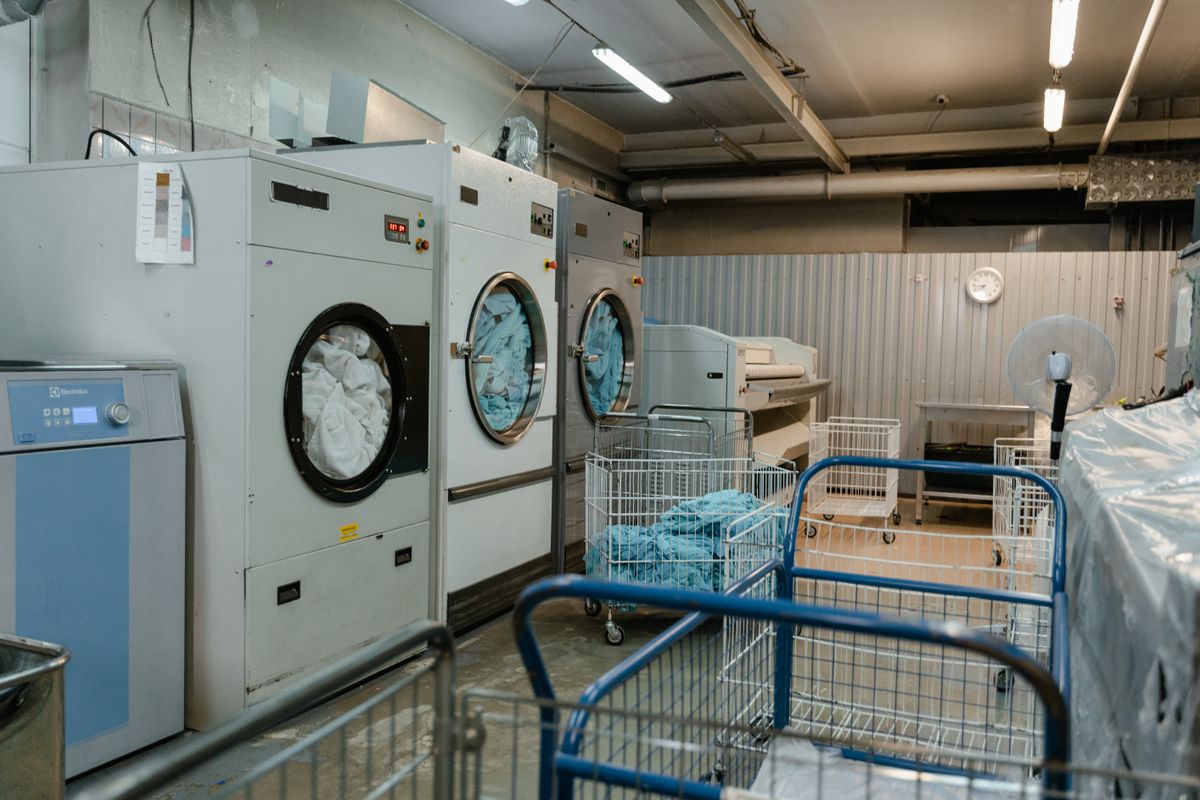
The reason this category exists at all is economic. Linen and uniform rental is a closed loop with an unusually high loss rate: items leave the building in a bag and are expected to come back. Without item-level identification, every count is an estimate, and every dispute with a customer is settled on trust. Item-level UHF identification changes that by turning each sheet, gown, or coverall into a record. Our RFID laundry tags range covers the main housing formats; silicone sits at the durability end of that range.
2. Inside the Tag: Antenna, Chip, and Why Silicone
2.1 The air interface is standardized, so any compliant reader can read it
Silicone laundry tags are built on the UHF passive backscatter interface defined in ISO/IEC 18000-63 — the same air interface as EPC Class 1 Gen 2, maintained by GS1 as the EPC Gen2 standard. Practically, that means a tag from one supplier can be read by another supplier’s reader, and the data on it can be understood by software built on GS1’s EPC Tag Data Standard. This is why we always recommend buying to the standard rather than to a vendor’s private protocol: it protects the laundry operator if the reader vendor changes five years later.
2.2 The antenna is tuned for wet textile, not for air
This is the part most specification sheets skip. Water has a high dielectric constant, so a tag buried in wet cotton is electrically not the same tag as one lying on a dry table: the resonant frequency shifts down and the read range drops. A laundry antenna is therefore designed with a meander or folded-dipole geometry that is deliberately over-tuned for dry conditions so that it lands near the middle of the band when the garment is soaked. Good suppliers test the finished tag on a wet substrate, not on a lab bench.
2.3 The chip choice defines memory, sensitivity, and features
Common options are Impinj Monza R6-P, NXP UCODE 8/9, and Alien Higgs-4/9. They differ in read sensitivity, EPC and user memory size, and optional features such as tag-integrity or brand-protection commands. EPC memory typically ranges from 96 to 496 bits depending on configuration; TID is 48 to 96 bits; user memory varies from none to several hundred bits. Treat the numbers on any datasheet as indicative and confirm them against the chip vendor’s own datasheet for the exact part number you are buying.
2.4 Why silicone rather than fabric or PPS
Silicone rubber is chemically inert, remains flexible from −40 °C up into the 200 °C range depending on grade, and does not become brittle after repeated caustic exposure — the failure mode that kills encapsulated labels in hospital laundries. Its weakness is mechanical rather than chemical: a soft tag can be torn out of a hem if it is sewn badly, and it is more expensive per piece than a woven label. Section 9 compares the three housing types side by side.
3. Specifications That Actually Decide the Project
The table below is the working specification for our standard silicone UHF laundry tag. Every row is a decision point: change the chip and you change the memory and the reader compatibility; change the size and you change the read range and where the tag can physically be attached.
| Parameter | Standard specification |
|---|---|
| Frequency | 860–960 MHz global UHF (US 902–928 MHz · EU 865–868 MHz) |
| Protocol | ISO/IEC 18000-6C, EPC Class 1 Gen 2 |
| Chip | Impinj Monza R6-P · NXP UCODE 8/9 · Alien Higgs-4/9; other Gen2 chips on request |
| EPC / TID / User memory | EPC 96–496 bit · TID 48–96 bit · user memory chip-dependent |
| Size | 55 × 12 × 2 mm standard; 34 × 16 mm, 50 × 15 mm, or fully custom |
| Housing material | Molded silicone rubber, flexible, chemically inert |
| Ingress protection | IP68 (dust-tight, continuous immersion — see note below) |
| Wash durability | 180 industrial wash and dry cycles |
| Operating temperature | −20 °C to +100 °C continuous |
| Read range | Up to 6 m with a standard fixed reader and antenna (item- and environment-dependent) |
| Write endurance / retention | 100,000 write cycles · 50-year data retention (chip-dependent) |
| Attachment | Sew-in, insert pocket, 3M adhesive backing, heat-seal, or hangtag |
| Colours | Black, white, blue standard; custom colours available |
| Marking | Laser engraving (serial number, logo, QR); silk-screen printing |
| Packing | 100 pcs/bag · 3,000 pcs/carton |
| Encoding | Factory pre-encoding to customer EPC scheme, with verification report |
※ This table scrolls horizontally on small screens.
3.1 Read range: the number on the datasheet is a best case
Six meters is achievable in a controlled setup. In a real laundry it is affected by four things, and you should expect to design for less:
- Moisture. Wet linen detunes the antenna and absorbs UHF energy; bulk reads of soaked items are shorter than dry reads.
- Metal. Cage trolleys, sorting conveyors, and tunnel washer shells reflect and shield RF. Tags facing a metal surface read poorly.
- Density. In a tightly packed trolley, tags shadow each other. Reading the trolley as it passes a portal works better than reading into a static pile.
- Regional power limits. Regulatory EIRP ceilings differ between markets (the EU and the US do not allow the same radiated power), so the same tag and reader will not give the same distance in Hamburg and Houston.
For a portal or tunnel reading point, plan on 1.5–3 m working distance and validate it with the actual linen mix. For handheld stocktaking, 30–80 cm through fabric is a more realistic expectation.
4. How They Are Made: From Inlay to Encapsulated Tag
The quality of a laundry tag is decided long before the silicone goes in. This is the process sequence we run, and it is the sequence worth auditing when you compare suppliers.
4.1 Step 1 — Antenna and inlay
The antenna is etched from aluminium on PET film (copper is used where tighter tolerance or higher conductivity is needed), then the bare die is flip-chip bonded to the antenna pads with anisotropic conductive paste and underfilled. The sheet is singulated into individual inlays. At this stage the inlay is fragile and completely unprotected — every subsequent step exists to keep it alive.
4.2 Step 2 — Bare-inlay test
Each inlay is tested for resonant frequency and read sensitivity before encapsulation. This matters: if you encapsulate a marginal inlay, you have made an expensive reject. Suppliers who skip inlay-level testing have a hidden scrap rate that shows up later as field failures.
4.3 Step 3 — Silicone encapsulation
Liquid silicone rubber is injected or compression-molded around the inlay in a steel tool. Two details separate a durable tag from a leaking one:
- Vacuum de-aeration. Air trapped in the compound becomes a void; a void becomes a water path after a few hundred thermal cycles. LSR is degassed before injection and the tool is vented.
- Bonding, not just covering. Platinum-cured silicone bonds to itself; it does not bond to PET. The inlay is therefore either mechanically encapsulated with sufficient wall thickness on all faces, or pre-coated with a primer so the rubber grips the film instead of delaminating around it.
4.4 Step 4 — Curing, trimming, and marking
Addition-cure (platinum) silicone is vulcanized at elevated temperature, post-cured to remove volatiles, then deflashed. Serial numbers, logos, or 2D codes are laser-engraved into the surface — laser marking is preferred over printing on laundry tags because there is no ink to wash off.
4.5 Step 5 — Encoding, wash testing, and QC
Finished tags are encoded to the customer’s EPC scheme and verified by reading back the written value. Durability is validated by cycling samples through industrial wash and dry procedures and re-measuring read rate at intervals rather than only at the end. The reference procedure for industrial laundering of workwear and PPE is ISO 15797:2017, which defines eight washing procedures plus tumble-drying and tunnel/cabinet finishing, and is explicit that a test should reproduce the procedure the garment will actually meet.
5. Customization Parameters
Laundry tags are almost always a custom part, because the tag has to fit a garment that already exists. These are the parameters we can change without a new tool, and the ones that need one.
| Parameter | Options | Tooling impact |
|---|---|---|
| Chip | Monza R6-P, UCODE 8/9, Higgs-4/9, other Gen2 | None |
| Size & shape | 55×12×2 mm, 34×16 mm, 50×15 mm, custom outline | New mold for a new outline |
| Colour | Black, white, blue, custom Pantone match | None (compound colour) |
| Sewing tunnels | 1 or 2 tunnels, tunnel width and position | Mold modification |
| Marking | Laser serial no., logo, QR / Data Matrix; silk-screen | None |
| EPC encoding | SGTIN, GIAI, GRAI, or a custom serial scheme, pre-written at factory | None |
| Attachment | Sew-in, pocket insert, 3M adhesive, heat-seal, hangtag | Depends on method |
| Packing | 100 pcs/bag, bulk carton, or pre-sorted by EPC range | None |
5.1 Choose the EPC scheme before you choose the tag
Decide what the tag has to identify — the individual item (serialized), the item type, or the container — because that determines the EPC coding scheme and, in turn, how your software will store history. GS1’s identifier keys (SGTIN for a serialized item, GIAI for an asset, GRAI for a returnable container) map directly onto laundry use cases: a rented gown is a GIAI asset, a bale of sheets moving between plants is a GRAI container. If the laundry also exchanges visibility events with customers or partners, EPCIS is the event standard that makes the handover auditable — “washed, packed, shipped, received” — instead of a spreadsheet.
If you are also preparing for product-level digital identity requirements, our guide to choosing RFID tags for the EU Digital Product Passport explains how the same tag decisions differ when the driver is compliance rather than operations.
6. Five Attachment Methods and How to Choose
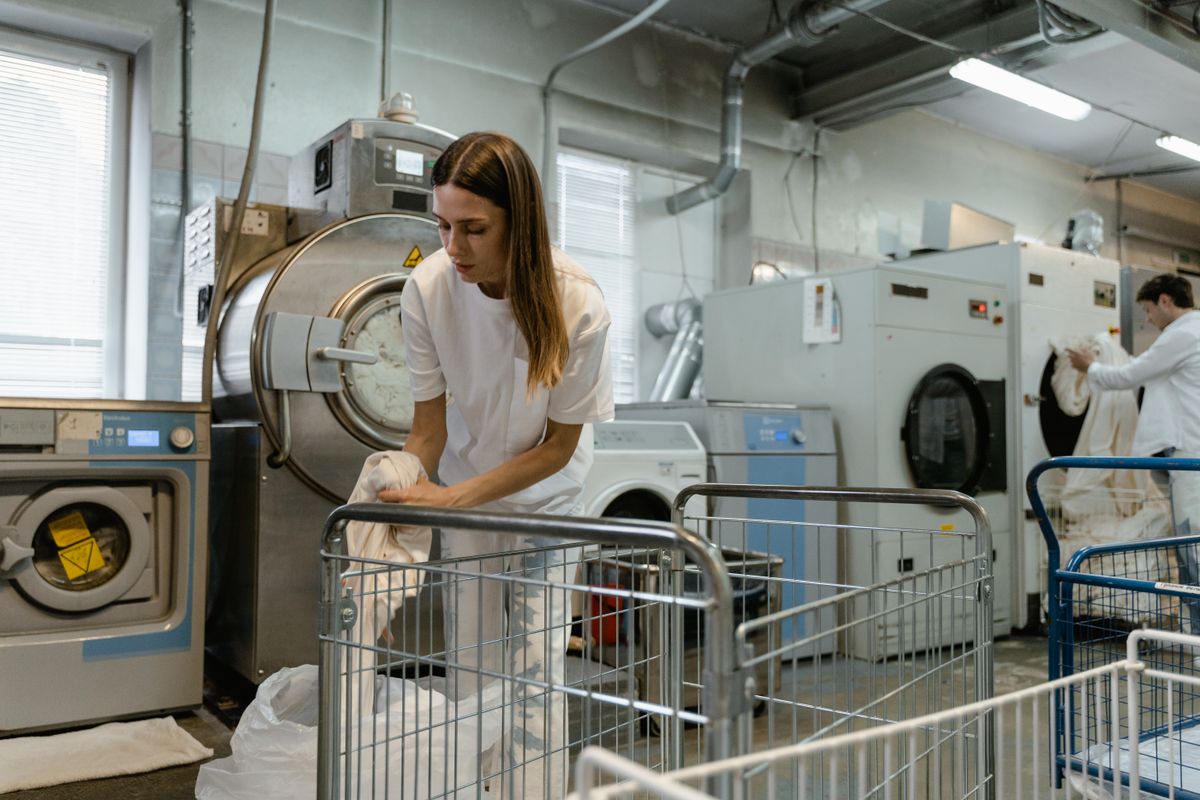
| Method | How it is done | Best for | Watch out for |
|---|---|---|---|
| Sew-in | Tag is stitched into a hem or seam allowance using the molded tunnels | Sheets, pillowcases, table linen, high-cycle workwear | Use the correct stitch length and a soft thread; a tight stitch cuts the silicone edge |
| Pocket insert | Tag drops into an existing or added pocket and is closed with a flap | Uniforms, scrub tops, patient gowns | Pocket must be closed before washing or tags migrate between garments |
| 3M adhesive | Pressure-sensitive backing applied to a flat textile surface | Retrofit programmes, hard-to-sew items | Performance depends entirely on surface energy and cleanliness; expect re-application |
| Heat-seal | Thermal bonding of a heat-seal layer to the fabric | High-volume garment production lines | Standard silicone is not heat-sealable; use a dedicated heat-seal construction so the bond, not the tag, is the weak point |
| Hangtag | Tag on a string or zip tie through a buttonhole or loop | Temporary trials, PPE that cannot be pierced | Breakage and removal risk — treat as semi-permanent |
Two practical rules from projects we have supplied. First, put the tag where the textile is double-layered: a hem, a waistband, a collar stand. Second, keep it away from the area that takes the most abrasion — the bottom corners of a sheet, the knee of a coverall. A tag that survives 180 washes in the lab will still be ripped out in week three if it is stitched to a single layer at a wear point.
7. Industry Applications and Real Scenarios
7.1 Hotel and hospitality linen
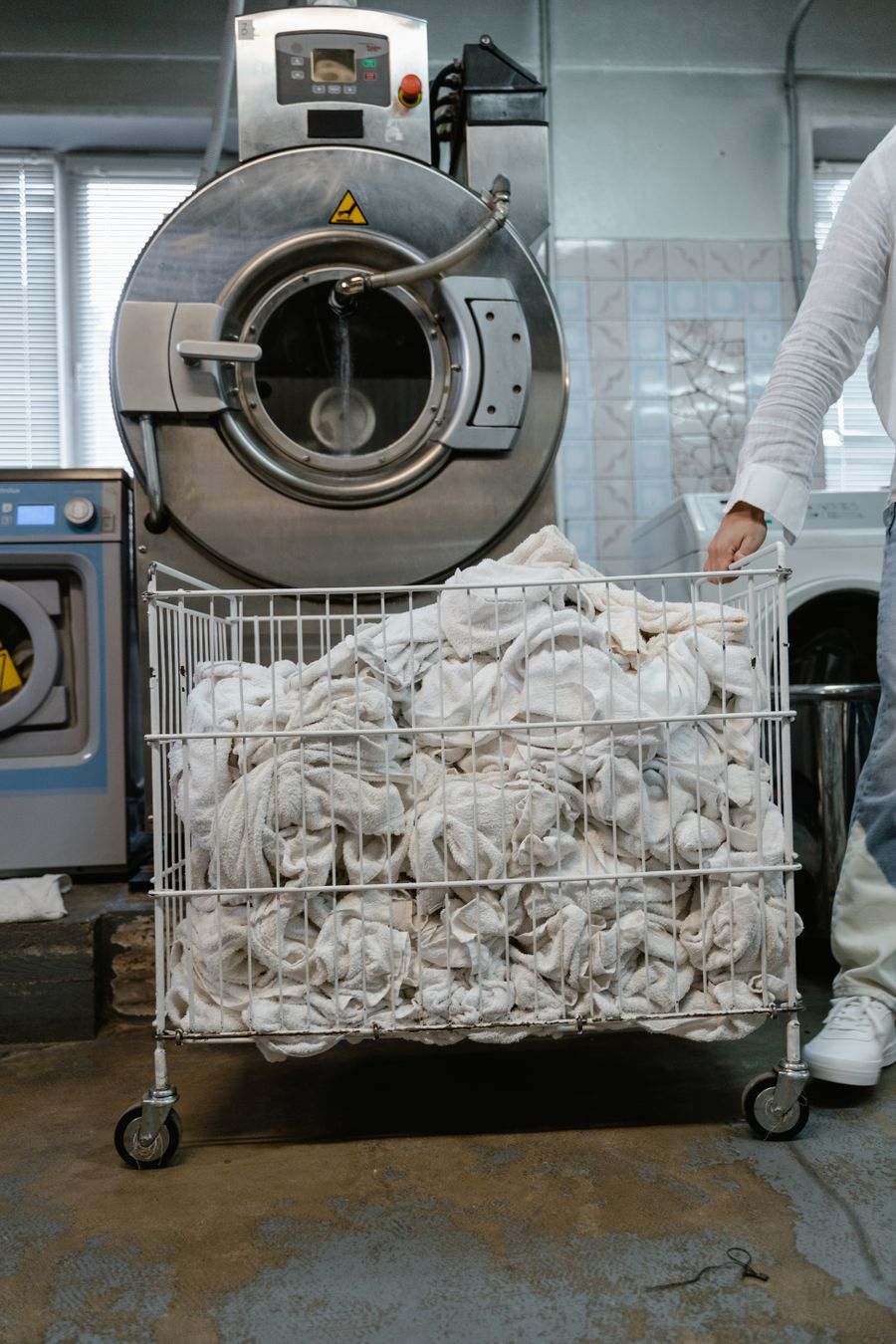
Bed sheets, duvet covers, towels, bathrobes, and table linen move through an outsourced laundry on a weekly rhythm. The operational questions are simple and expensive: how many pieces went out, how many came back, and which property is short. With a tag in the hem and a portal reader at the dock, both counts are automatic, and loss is attributed per property instead of absorbed centrally. Silicone is preferred here over woven labels when the linen is washed at high temperature with strong bleaching, or when towels are processed in a tunnel washer where mechanical action is continuous.
7.2 Hospitals and healthcare laundries
Healthcare is the most demanding version of the same problem. Scrubs, lab coats, patient gowns, and surgical textiles must be accounted for individually, and the laundry process itself is audited: the Healthcare Laundry Accreditation Council accredits laundry operations against standards covering soiled/clean separation, temperature, and chemistry. A tag that survives that chemistry is a prerequisite; a tag that records which batch a gown went through turns an inspection question into a report. This is where silicone’s resistance to caustic and chlorine pays for itself, and where a cheap encapsulated label fails fastest.
7.3 Workwear and uniform rental
Rental contracts are billed per piece per week, so the count is the invoice. The Textile Rental Services Association tracks this industry’s operating benchmarks, and garment circulation is one of the levers operators watch most closely: faster turnaround on the same fleet means fewer garments bought. Tagging coveralls, chef whites, and industrial uniforms at the pocket or hem makes sorting at the plant automatic, and lets the operator prove garment condition and replacement dates when a customer disputes a charge.
7.4 Firefighter PPE and technical protective clothing
Turnout gear, helmets, and technical rescue clothing have a documented cleaning and inspection history requirement. ISO 15797 was written for exactly this class of garment, and silicone tags are used because they tolerate both the wash chemistry and the drying step without deforming. Here the tag is as much a compliance record as an inventory device — the value is the inspection and cleaning history attached to a serial number.
7.5 Commercial laundry automation
The highest-throughput use is automated sorting: garments are read on a conveyor, the system routes them by customer, colour, or fabric, and the tunnel washer receives them in the right batch. That requires the reader to be synchronized with the conveyor and the software to hold a buffer of read events — a systems question, not a tag question, but it is where projects fail if the tag’s read rate is inconsistent at speed.

8. Running a Pilot: A 90-Day Plan
We recommend testing before scaling, because read performance is a property of the whole system — tag, attachment point, textile, reader, antenna position, and workflow. A pilot that answers four questions is enough to commit.
- Weeks 1–2, tag trials. Tag 50–100 pieces of your most common linen mix, at the attachment point you intend to use. Include the worst case: the thickest towel, the darkest colour, the smallest item.
- Weeks 2–6, read-rate baseline. Measure read rate at each reading point (soiled intake, tunnel exit, sorting, packing). Record it before the tags have been washed so you have a baseline to compare against.
- Weeks 6–12, durability in service. Let the tagged items go through the real process. Re-measure read rate at 25, 50, and 100 cycles. Watch for physical failures — tears at the stitch line, delamination, tag loss — as closely as electronic ones.
- Week 12, decision. Compare read rate against the number your workflow actually needs, not against the datasheet. If you need 99.5 % at the sorting point and you are at 96 %, the fix is usually antenna placement or conveyor speed, not a different tag.
A specification checklist for the RFQ: air interface and chip part number; frequency band for each destination market; EPC scheme and who encodes; housing material and wall thickness; attachment method and stitch instructions; wash procedure used for the cycle claim; IP rating with test conditions; expected read distance at each reading point; sample quantity and lead time. Suppliers who answer all nine are the ones worth a second conversation. Our UHF RFID reader-writers and RFID printers pages cover the reader and encoding side of the same decision.
9. Silicone vs. Textile vs. PPS Laundry Tags
There is no universally best housing. Each one wins a different trade-off, and a mixed fleet is normal — hospital gowns in one format, hotel sheets in another.
| Silicone UHF | Textile / woven | PPS button | |
|---|---|---|---|
| Wash cycles (typical claim) | 180 | 200+ | 200 |
| Chemical resistance | Excellent — inert, tolerates caustic and bleach | Good, but the woven edge frays over time | Excellent |
| Flexibility | High — bends with the textile | Highest — it is a textile | Rigid |
| Profile | ≈2 mm | <1 mm | 3–5 mm rigid dome |
| Cost per piece | Mid–high | Lowest | Mid |
| Read range | Up to 6 m | Typically 1–4 m | Up to 5 m |
| Attachment | Sew, pocket, adhesive, hangtag | Sew-in only | Sew hole, button loop, pocket |
| Best fit | Chemically aggressive laundries, towels, PPE | High-volume, cost-driven linen | Uniforms, garments needing a hard-wearing button |
See the dedicated pages for textile RFID laundry tags and PPS button RFID tags, or the PPS button NFC laundry tag guide if you are working in an HF/NFC environment instead of UHF. If your process includes a heat-seal step rather than sewing, the silicone heat-seal NFC tags are the correct construction — standard silicone tags should not be heat-sealed. And if the requirement is a rigid button on a garment loop, the washable UHF RFID button is the better starting point. For non-laundry silicone formats, see the wider silicone RFID tags range.
10. Frequently Asked Questions
What is the difference between a silicone laundry tag and a textile laundry tag?
Both are UHF tags for industrial laundry; they differ in housing. A textile tag is a thin woven label with the antenna embroidered or laminated inside — cheapest per piece, lowest profile, typically sewn in and rated for 200 or more cycles. A silicone tag is a molded rubber body around the inlay — thicker, more expensive, but sealed against water and chemicals and far more tolerant of caustic and bleach-heavy programmes. If your laundry runs aggressive chemistry or processes towels and PPE in a tunnel washer, silicone is usually the right call. For high-volume hotel linen washed on a milder programme, textile is often the better cost decision.
Can silicone RFID tags survive tunnel washers and high-pressure extraction?
Yes, provided the tag is correctly attached. The failure point in a tunnel washer is rarely the tag body — it is the attachment: a stitch that cuts the silicone edge, or a single-layer attachment at a high-abrasion corner. Attach at a double layer, use a soft thread with a moderate stitch length, and validate in your own tunnel rather than relying on a lab claim.
Does wet linen reduce the read range?
Yes. Water absorbs UHF energy and shifts the tag’s resonant frequency, so a tag read through soaked cotton will not reach the same distance as the same tag on dry fabric. A well-designed laundry antenna is over-tuned to compensate, which is why you should ask for the read distance measured on wet textile rather than on a dry bench. Metal trolleys and conveyors reduce it further.
What temperature can the tag take during drying?
The standard part is rated for continuous operation from −20 °C to +100 °C. Drying is a different exposure — higher temperature for a shorter time — so the right approach is to tell us the drying method (tumble dryer, tunnel finisher, cabinet) and the peak temperature at the garment surface, and validate with sample tags in your process. Do not assume the continuous rating covers an unstated drying peak.
Can the tags be delivered already encoded with our numbers?
Yes. We encode to your EPC scheme at the factory — SGTIN, GIAI, GRAI, or a custom serial range — and verify each tag by reading the written value back before packing. If your software needs a defined serial block per customer or per property, tell us the allocation at the quotation stage so the encoding plan is built into production rather than applied afterwards.
What is the minimum order and can we get samples?
No strict minimum — trial quantities are fine. Evaluation samples ship in about 3–5 working days. Email [email protected] with the chip, size, and attachment method you have in mind, and we will send a sample built to that configuration; a generic sample that does not match your attachment point will tell you nothing useful about read rate.
Specifying silicone RFID laundry tags for a project?
Tell us the textile, the wash programme, and the reading point. We will recommend a chip, a size, and an attachment method — and send a sample that matches.