
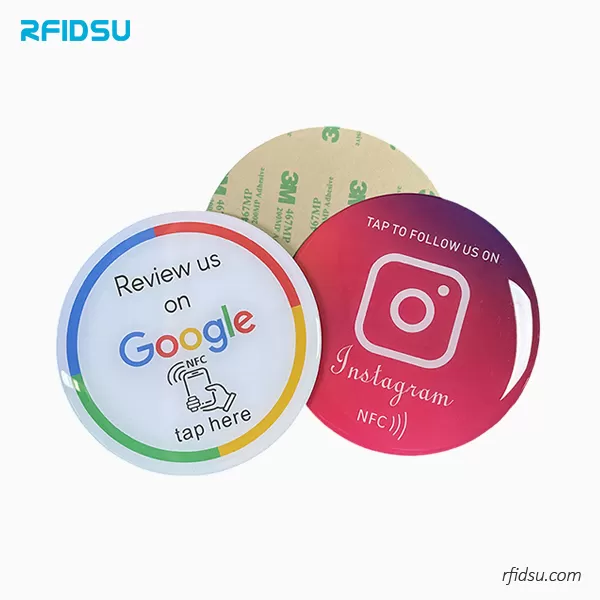
If you run a restaurant, a salon, a clinic or a retail counter, you already know the pattern: a customer walks out happy, means to leave a Google review, gets home — and never does. The intention is real; the friction kills it. Searching your business name, finding the right listing, locating the review button — every step loses people. An NFC Google review plate collapses that whole journey into one tap: the customer holds their phone near the plate and your review form opens instantly.
Over the past two years this has quietly become one of the highest-volume products in the NFC hardware category. Marketplace listings for Google-review NFC cards and plates show five-figure monthly sales, and the same questions come up again and again in owner communities like r/smallbusiness and r/sweatystartup: which chip, which material, will people cheat the link, will Google penalize it? This guide answers those questions the way a manufacturer sees them — from the chip die to the counter surface.
In this article
- Why NFC review plates are selling so well right now
- How a tap-to-review plate works, and what is inside it
- NTAG213 vs NTAG215 vs NTAG216: which chip to order
- PVC, epoxy, acrylic or wood: choosing the housing
- Encoding: direct link, dynamic redirect and locking
- Google’s rules: what a review plate can and cannot do
- Where to place it — and what staff should say
- Five real setups, from café counter to e-commerce insert
- Common failure modes and how to avoid them
- FAQ
- References & Further Reading
1. Why NFC Review Plates Are Selling So Well Right Now
Three forces came together at the same time, and they explain why resellers, marketing agencies and individual venues are all ordering this product in volume.
Local ranking now runs on review velocity. Fresh, recent reviews weigh heavily in Google Maps ranking and in the AI-generated answers that increasingly summarize local businesses. A profile with a steady trickle of new reviews outranks a profile with a wall of old ones — which turned “collecting reviews continuously” from a nice-to-have into an operating requirement.
Tap completion beats every other method by a wide margin. Conversion tracking published by review-hardware vendors shows tap-to-open flows completing at roughly 60–70%, versus a few percent for QR-only signs and well under 2% for a purely verbal ask. The physics is simple: the tap happens at the counter, in the thirty seconds when goodwill is highest, and requires zero searching.
One-time hardware beat subscription software. The first generation of review products bundled the NFC chip with a monthly-fee redirect service. Venues pushed back — if the subscription lapses, the plate dies. The market shifted toward plates encoded with a direct review link (or a redirect the business owns), bought once and used for years. That is exactly the configuration we manufacture: pre-encoded, locked, no app, no monthly fee.
2. How a Tap-to-Review Plate Works, and What Is Inside It
There is no battery and no electronics beyond a chip and an antenna. The plate contains a passive NFC tag — an NXP NTAG-series chip bonded to an etched antenna, encapsulated in the housing material. When an NFC phone comes within a few centimetres, the phone’s own radio field powers the tag, reads the stored NDEF URL record, and the operating system offers to open it. The whole interaction takes under two seconds and is standardized at ISO/IEC 14443 with NFC Forum Type 2 tag operation — which is why every modern iPhone (XS and later) and most Android phones from 2019 onward read it natively, no app required. The NFC Forum maintains the tap-interaction specifications that make this uniform across brands.
Inside the housing, three construction details decide real-world reliability:
- Antenna size. A larger antenna gives a more forgiving read zone, which matters when customers tap at an angle, one-handed, with a coffee in the other hand. This is why our best-selling sizes are Ø100 mm round and 100×100 mm square rather than small stickers.
- Chip-to-antenna bond quality. A plate on a busy counter gets knocked, wiped and flexed. A weak bond survives the factory bench test and fails at week six. This is where low-cost tags separate from production-grade ones.
- Adhesive system. Counter plates live or die by the mount. Our round plates ship with 3M 9448A double-coated tissue tape backing — it holds on laminate, sealed wood and glass, and peels cleanly when you reposition.
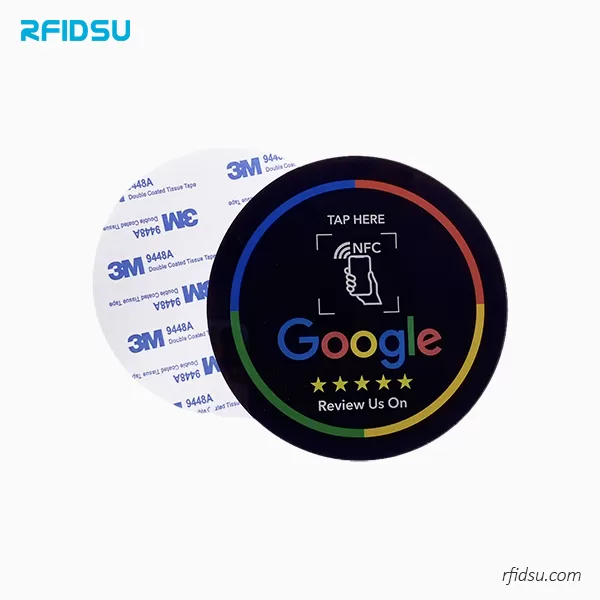
Every plate we ship also carries a printed QR code encoding the same review link. This is not decorative — a meaningful share of customers keep NFC switched off, and iPhone models older than the XS need the reader opened from Control Center. The QR is the fallback that means nobody at the counter is left out. If a seller offers an NFC-only plate without a QR, skip it.
3. NTAG213 vs NTAG215 vs NTAG216: Which Chip to Order
All three chips are ISO/IEC 14443A, NFC Forum Type 2, and behave identically at the counter. The only meaningful difference is memory — and since a review URL uses perhaps 60–80 bytes, even the smallest chip holds it comfortably. Here is the decision logic we give customers:
| Parameter | NTAG213 | NTAG215 | NTAG216 |
|---|---|---|---|
| Usable memory | 144 bytes | 504 bytes | 888 bytes |
| Fits a review URL | Yes, easily | Yes | Yes |
| Fits a long redirect URL + tracking parameters | Tight but usually OK | Yes | Yes |
| Originality signature | Yes | Yes | Yes |
| Relative cost | Lowest | Mid | Highest |
| Best for | Standard review plates, volume orders | Multipurpose plates (review + social + menu links), the safe default for resellers | Plates that must hold multiple NDEF records or app-launch payloads |
Our recommendation in one line: NTAG213 for pure review plates at volume, NTAG215 if you want headroom or resell to mixed-use customers, NTAG216 only when a spec sheet genuinely demands it. Paying for 888 bytes to store a short link is money that buys nothing.
4. PVC, Epoxy, Acrylic or Wood: Choosing the Housing
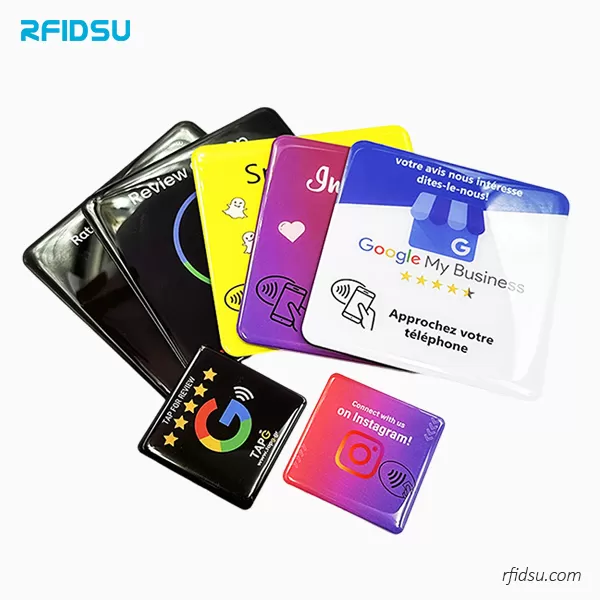
The housing decides the look, the durability and the price. All four options below are full-colour printable (CMYK or Pantone) and available with the anti-metal layer for metal counters.
| Material | Profile | Durability in service | Best fit |
|---|---|---|---|
| PVC (0.84–1 mm) | Thin, flexible-to-rigid, lowest cost | Handles daily counter use; edge wear after long service | Volume orders, giveaways, multi-location rollouts |
| Epoxy dome (2–3 mm) | Glossy resin dome over print | Waterproof, wipeable, scratch-resistant — survives wet hands and sanitizer | Restaurants, cafés, salons — the all-round default |
| Acrylic (2–3 mm) | Rigid, premium glass-like finish | Very durable surface; can crack under hard impact | Upscale venues, reception desks, clinics |
| Wood (2–3 mm) | Natural grain, matte, moisture-finished | Good with light moisture; not for wet-wipe cleaning regimes | Cafés, boutiques, eco-positioned brands |
One housing question decides more projects than any other: is the surface metal? A standard NFC tag mounted on a steel counter or a metal table pedestal is detuned by the metal and reads unreliably or not at all. For those surfaces order the anti-metal version, which adds a ferrite isolation layer between antenna and plate. If you are unsure, tell us the mounting surface when you request samples and we will build the sample to match.
5. Encoding: Direct Link, Dynamic Redirect and Locking
What gets written to the chip — and who controls it — matters more than the hardware itself. There are two workable architectures:
Direct link (recommended for single-location venues). The chip stores the Google review URL itself. No middleman, nothing to subscribe to, nothing that can expire. The limitation is that the link is fixed once the tag is locked — if Google changes your URL format, you re-encode or reorder. Get the correct link from your Google Business Profile via Ask for reviews; it should land customers on the review form, not on your profile page.
Redirect link you own (recommended for agencies and multi-location brands). The chip stores a short URL on a domain you control, which 301-redirects to the review page. You can repoint every plate in a chain from one dashboard, add per-location tracking, and swap review platforms without touching hardware. If you go this route, the redirect domain must be yours — plates that stop working when a vendor’s subscription lapses are the single most common complaint in owner forums.
Locking is non-negotiable for public plates. An unlocked NTAG chip can be rewritten by anyone with a free phone app — a bored teenager (or a competitor) can point your counter plate somewhere you do not want it. We set the read/write lock bits at the factory after encoding, so the stored link is permanent. For plates you plan to encode yourself, lock them after writing — most NFC apps have a “lock tag” option, and our guide to programming NFC tags on iPhone walks through the process.
6. Google’s Rules: What a Review Plate Can and Cannot Do
A review plate is a compliance tool as much as a marketing one — used correctly, it is fully within Google’s policies; used carelessly, it can get reviews removed or a profile suspended. The rules that matter, straight from Google’s own pages (prohibited and permitted practices, Maps user-generated content policy):
- Asking is allowed; incentivizing is not. You may solicit reviews from customers. You may not offer discounts, free items, donations or any other benefit in exchange for a review — and since the policy tightened, that extends to benefits offered merely to get an existing negative review edited or removed.
- Review gating is banned. Do not route customers through a “how was your experience?” filter page that shows the Google link only to happy customers and sends unhappy ones to a private form. Google prohibits selectively soliciting positive reviews, and gated funnels get flagged.
- Send everyone to Google. A compliant plate opens the same public review page for every customer, good day or bad. This is also why we decline to pre-encode filter-style URLs on plates we manufacture.
- No staff, family or conflict-of-interest reviews, and never discourage or suppress negative reviews — including through the wording on the plate itself.
Note the practical upside of compliance: a plate with a plain “Tap or scan to review us on Google” prompt and a direct link is one of the few review-collection methods that is simultaneously high-converting and policy-clean.
7. Where to Place It — and What Staff Should Say
Forum threads from business owners converge on the same verdict: the plate is a friction-remover, not an ask-replacer. A plate sitting silently by a register collects almost nothing; the same plate paired with a one-line verbal ask collects steadily. The working playbook:
- Put it where money changes hands — the checkout counter, the payment terminal side, the reception desk, the table where the bill lands.
- Eye level or hand level, facing the customer. Nobody taps a plate they cannot see.
- Beside, not on, the card reader. Keep distance from payment terminals, and never mount a standard tag on a metal counter (use the anti-metal build instead).
- Anchor it properly. A plate lighter than about 100 g slides when the phone presses it. Clean the surface before applying the 3M backing, press for ten seconds, and let it cure before the rush.
- Train the ask: “If you enjoyed it today, a quick tap on that Google plate helps us a lot — it takes ten seconds.” One sentence, at the moment the customer is happiest.
8. Five Real Setups, from Café Counter to E-commerce Insert

Restaurant / café. Ø100 mm epoxy plate on each table plus one at the POS counter. The table plate catches the post-meal peak; the counter plate catches takeaway customers. Encode the same link; expect the counter position to outperform tables, because staff point at it.
Beauty salon / spa. Acrylic plate at the reception mirror line — the “reveal moment” is the highest-goodwill second of the entire visit. One plate per stylist station works better than one at the door.
Dental / medical clinic. A rigid acrylic plate at checkout with the QR as the primary prompt (many patients keep NFC off). Compliance matters most here: no gating, no incentives — the plate simply shortens the path.
Hotel. A plate at reception checkout plus, for larger properties, plates in-room linked to the review page. Multi-location brands should use owned-domain redirect links with a location parameter so every tap is attributable to a property.
E-commerce after-sales. A small PVC card in the shipping box, pre-encoded to the product review page — the plate technology in card form. See our Google review NFC cards for the credit-card format, and the table-stand version where a freestanding display works better than an adhesive plate.
9. Common Failure Modes and How to Avoid Them
- Metal surface, standard tag. Reads unreliably or not at all. Fix: anti-metal build.
- Thick phone cases and metal-plate mounts. Some rugged cases and magnetic car-mount plates shield the antenna. This is the argument for keeping the QR code on the plate — the scan path always works.
- Tap-point confusion. The NFC antenna sits at different spots on different phones (top-back on iPhones, centre-back on many Androids). A printed “tap here” prompt with the hand icon reduces failed taps dramatically.
- Unlocked tag. Public plates get rewritten as a prank. Fix: factory lock bits set after encoding.
- Wrong link. The profile URL makes customers hunt for the review button; the review form URL does not. Test the encoded plate with three phones before rollout — ours are read-verified before packing.
- Adhesive failure. Greasy or textured surfaces peel plates off within days. Clean with isopropyl alcohol, press firmly, cure 24 h under light load.
10. FAQ
Do customers need an app to use the plate?
No. Any NFC-enabled smartphone — iPhone XS and later, most Android phones from 2019 onward — reads the plate with a tap. The printed QR code covers phones with NFC switched off.
Which size should I order?
Ø100 mm round and 100×100 mm square are our best sellers — visible from across a counter without dominating a table. Ø75 mm and 80×80 mm suit tight spaces; 120 mm formats suit wall mounting and high-traffic venues.
Can the plate link to something other than Google reviews?
Yes — the chip stores any URL: Yelp, TripAdvisor, Instagram, TikTok, a menu, a booking page. One plate can even carry a review link for the venue while a second, social-follow plate sits beside it, as many cafés do.
Is the encoded link permanent?
The link written to the chip is permanent once locked — that is a feature, protecting the plate from tampering. If you need to change destinations later, order plates with a redirect link on a domain you control, or ask us about re-writable configurations for internal use.
What is the minimum order quantity?
No strict MOQ — trial quantities are fine. Evaluation samples ship in 3–5 working days, built to your exact configuration (chip, size, material, encoding). Email [email protected] with your mounting surface and target link, and the sample you receive will match your real deployment rather than a generic demo unit.
Can you pre-encode and lock at the factory?
Yes. Send the review URL (or a per-location URL list) with your artwork; we encode, verify each tag by reading it back, set the lock bits, and pack per location. For chains, we can also allocate a serial block per branch so your software can distinguish locations.
Does a wet or dirty counter surface affect the NFC read?
Liquid on the surface slightly detunes the antenna, but at tap distance (0–7 cm) the effect is negligible for epoxy and acrylic builds — which is one reason they are the standard for restaurants. Wipe the surface as part of normal cleaning and the plate performs the same on day 500 as on day one.
How long does the chip last?
NTAG-series chips are rated for 100,000 write cycles and 10 years of data retention — and since a review plate is written once and read thousands of times, the practical limit is the housing, not the silicon.
11. References & Further Reading
- Google Business Profile, Prohibited and permitted content — support.google.com/business/answer/2622994
- Google Maps, User-contributed content policy — support.google.com/contributionpolicy
- ISO/IEC 14443-1:2018, Cards and security devices for personal identification — Contactless proximity objects — Part 1: Physical characteristics — iso.org/standard/73596
- NFC Forum, What NFC Does — nfc-forum.org/learn/what-nfc-does
- NXP Semiconductors, NTAG213/215/216 — NFC Forum Type 2 Tag datasheet — nxp.com/docs/en/data-sheet/NTAG213_215_216.pdf
Get Samples Built to Your Counter
RFIDSU manufactures Google review plates in PVC, epoxy, acrylic and wood — pre-encoded with your review link, factory-locked, with anti-metal options for steel surfaces. No MOQ, free samples, 3–5 day dispatch.