
A laundry tag used to be a printed barcode that smeared after ten washes. Today, it can be a sealed button that survives 200 trips through an industrial washer, gets tapped by a smartphone, and quietly tracks a garment through its entire working life. That is the promise of PPS button NFC laundry tags: high-temperature engineering plastic molded around an NFC chip, in a Ø15 mm button small enough to sew into a seam and tough enough for autoclave sterilization.
In this guide we break down what these tags actually are, why hospitals, hotels, and uniform rental programs rely on them, and what separates a PPS button tag that lasts from one that cracks under heat. If you are evaluating tags for linen management, uniform tracking, or anti-counterfeiting, this is the practical context you need before placing an order.
In this article
- What Are PPS Button NFC Laundry Tags?
- Why They Survive Industrial Laundry
- Why Choose RFIDSU’s PPS Button NFC Laundry Tags
- Frequently Asked Questions
1. What Are PPS Button NFC Laundry Tags?
A PPS button NFC laundry tag is a small, round identification tag molded from PPS (Polyphenylene Sulfide) — a high-temperature engineering plastic — with an NFC chip and antenna sealed inside. It measures Ø15 mm across and just 3 mm thick, with a 2 mm center hole so it can be sewn onto fabric like a button. Unlike a printed label that sits on the surface, the electronics here are fully encapsulated in the plastic body, protected from water, heat, and detergent.
The tag operates at 13.56 MHz (HF NFC) under the ISO 14443A / NFC Forum Type 2 standard, with a read range of 1–3 cm — short by design, optimized for one-to-one smartphone taps and close-range industrial scanning rather than long-distance bulk reading.
At a technical level, a PPS button NFC tag contains four elements:
- The PPS body — a molded round button that forms both the visible tag and the protective casing for the electronics.
- The NFC chip — a passive IC (no battery) that stores a small amount of data: a URL, a serial number, or an NDEF message. Standard options are NTAG213, MIFARE Classic 1K, and Fudan F08.
- The antenna — a flexible conductive coil embedded in the button that powers the chip inductively when a phone or reader comes within 1–3 cm.
- The seal — the overmolded PPS shell that locks the chip and antenna inside, waterproof and chemically resistant, through repeated washing.
How a tap works in practice
When a worker or guest holds an NFC-enabled phone within about 3 cm of the button, the phone’s RF field powers the chip, which transmits its stored data. Depending on what was encoded at the factory, the tap can open an inventory record, display a wash-cycle count, show care instructions, or confirm authenticity — all without an app and without line-of-sight scanning.
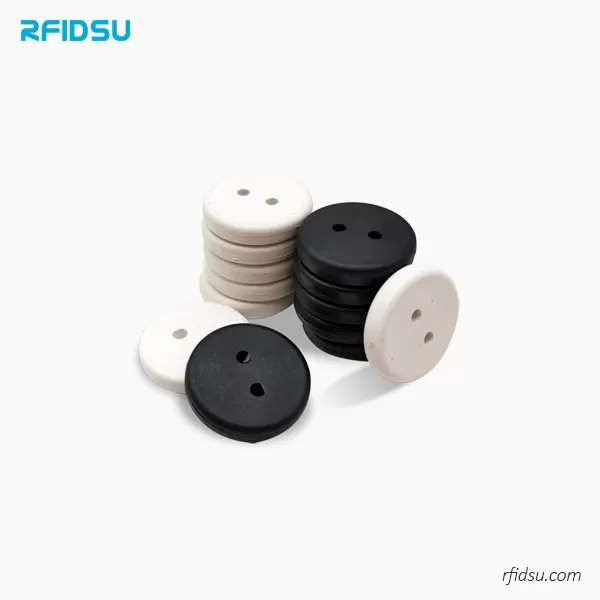
PPS Button NFC Laundry Tags — Ø15 mm overmolded button with center sew hole, built for industrial wash and sterilization.
2. Why They Survive Industrial Laundry
The reason a PPS button tag outlasts a printed label or a sewn-in paper tag comes down to four things the material and design get right.
200 industrial wash cycles, not a guess
These tags are rated for approximately 200 complete industrial wash and dry cycles with consistent NFC read performance throughout their service life. That is not a lab estimate — it reflects the overmolded PPS shell sealing the chip and antenna away from water, detergent, and mechanical agitation. For a rental uniform reused hundreds of times, that durability is the difference between a tag that tracks the garment and one that has to be replaced mid-program.
PPS engineering plastic beats heat and chemicals
PPS (Polyphenylene Sulfide) is a high-performance engineering plastic known for exceptional heat resistance up to 200°C, excellent chemical resistance, and dimensional stability. It is the ideal material for tags that must survive autoclave sterilization, industrial drying, and exposure to harsh detergents without deforming or degrading — conditions that melt or crack commodity plastics.
Button design with sew hole — discreet and secure
The Ø15 mm round button with a 2 mm center hole allows secure sew-through attachment, the same way a button is fixed to a garment. At only 3 mm thick, the tag hides easily in a seam or garment edge without affecting wearer comfort, and it cannot peel off the way an adhesive label can.
The temperature envelope: −30°C to +200°C
PPS material operates reliably from −30°C to +200°C, covering refrigerated storage, high-temperature industrial drying, and autoclave sterilization at 121°C or 134°C. The tags also resist perchloroethylene and other dry-cleaning solvents, making them suitable for dry-cleaning processes as well.
Unlike UHF RFID laundry tags that bulk-scan hundreds of garments from meters away, a PPS button NFC tag is built for close-range, one-to-one interaction — authentication, item-level records, and smartphone taps. Many programs use both: NFC for the human-facing tap, UHF for back-of-house tunnel washers. They are different product classes for different operating envelopes.
3. Why Choose RFIDSU’s PPS Button NFC Laundry Tags
Not all PPS button tags are molded to the same standard. The difference between a tag that fails after 20 washes and one that survives 200 is not luck — it is material selection, antenna design, overmolding process, and chip integration. RFIDSU’s PPS Button NFC Laundry Tags are built with the chip, antenna, and overmolding controlled in-house, and the result shows up in six concrete ways.
1. Real PPS overmolding — not a glued coin
The tags are molded from genuine high-temperature PPS engineering plastic, with the chip and antenna fully encapsulated inside the button. This is the same construction used for industrial textile tracking, not a disc with a chip laminated on the surface that can delaminate under heat.
2. Multi-chip NFC compatibility
Different use cases need different silicon. RFIDSU supports NTAG213 (144 bytes), MIFARE Classic 1K (768 bytes user memory), and Fudan F08, with 125 kHz or ISO 15693 options on request — so the tag is matched to the actual requirement rather than forcing a one-size-fits-all choice.
3. Wash durability engineered and tested
The tags are rated for about 200 industrial wash cycles with full NFC functionality retained. This reflects the overmolding process that locks the electronics inside the PPS shell, protecting them from water, detergent, and mechanical stress through repeated industrial laundering.
4. Extreme temperature range
With a continuous service temperature up to 200°C, the tags handle autoclave sterilization and high-temperature drying that would destroy ordinary plastic tags — validated through repeated sterilization and wash cycles while maintaining read performance.
5. Factory pre-encoding — ship ready to deploy
RFIDSU can encode each tag at the factory with your specified URLs, serialized numbers, or custom NDEF messages before shipping. The tags arrive plug-and-play — no in-house encoding equipment, no batch-management software, no risk of inconsistent writes. Blank tags are also available for customers who prefer to encode in-house.
6. Full OEM/ODM customization
Because RFIDSU is the manufacturer, customization runs the full stack: chip selection, custom sizes (Ø9.8 mm up to Ø50 mm, with or without center holes), Black or White color, silk-screen or laser-engraved logos and serial numbers, and custom packaging. Quality is controlled from antenna design through final delivery.
4. Frequently Asked Questions
What is PPS material and why is it used for laundry tags?
PPS (Polyphenylene Sulfide) is a high-performance engineering plastic known for exceptional heat resistance up to 200°C, excellent chemical resistance, and dimensional stability. It is the ideal material for laundry tags that must survive autoclave sterilization, industrial drying, and exposure to harsh detergents without deforming or degrading.
How are these button tags attached to garments?
Each tag has a 2 mm center hole, allowing it to be sewn directly onto fabrics like a button. The tag can also be inserted into a fabric pocket at the garment edge. The compact 3 mm thickness ensures comfort and concealment.
Which chip should I choose for my application?
NTAG213 (144 bytes user memory) is ideal for basic NFC applications like URL linking and simple ID storage. MIFARE Classic 1K (768 bytes user memory) offers more storage and cryptographic features suited to access control and complex data. F08 is a cost-effective alternative compatible with MIFARE 1K. RFIDSU can help you select based on your specific needs.
Can these tags survive autoclave sterilization?
Yes. The PPS material has a continuous service temperature of up to 200°C, making these tags suitable for autoclave sterilization at 121°C or 134°C. The tags have been tested through repeated sterilization and industrial wash cycles while maintaining NFC read performance.
What is the minimum order quantity and can I get samples?
RFIDSU offers flexible MOQ with no strict minimum. Free samples are available for evaluation, typically dispatched within 3–5 business days. Reach out with your chip type and quantity requirements to request samples.