
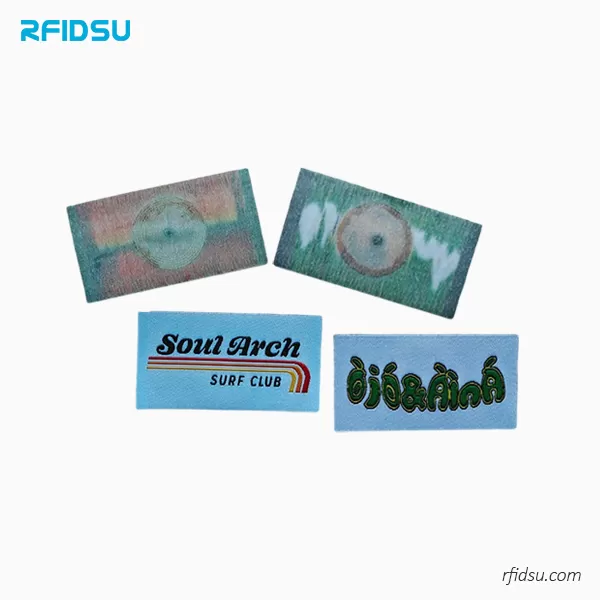
A woven label used to be just a logo stitched into a collar. Today, it can be a secure digital
touchpoint — one that authenticates a product, links a customer to brand content, and survives
100 trips through the washing machine. That is the promise of washable woven NFC tags:
traditional textile craftsmanship fused with near-field communication chips, in a single label
that looks premium and works quietly in the background.
In this guide we break down what these tags actually are, why apparel brands and uniform programs
are adopting them, and what separates a well-engineered woven NFC label from a generic printed sticker.
If you are evaluating tags for a clothing line, a uniform program, or an anti-counterfeiting rollout,
this is the practical context you need before placing an order.
In this article
1. What Are Washable Woven NFC Tags?
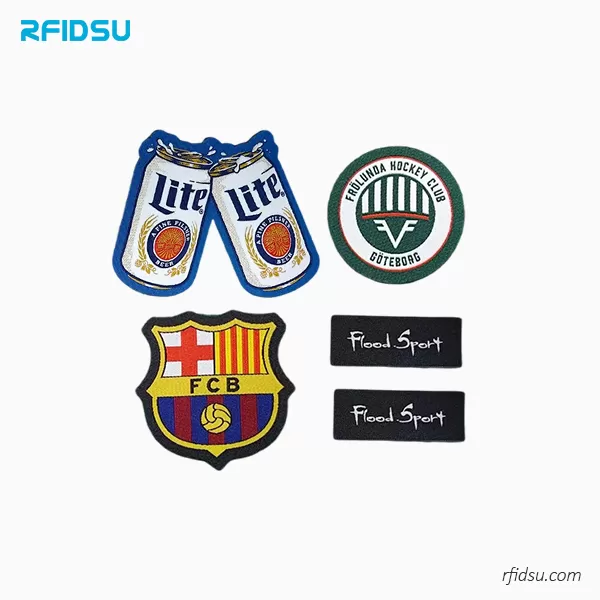
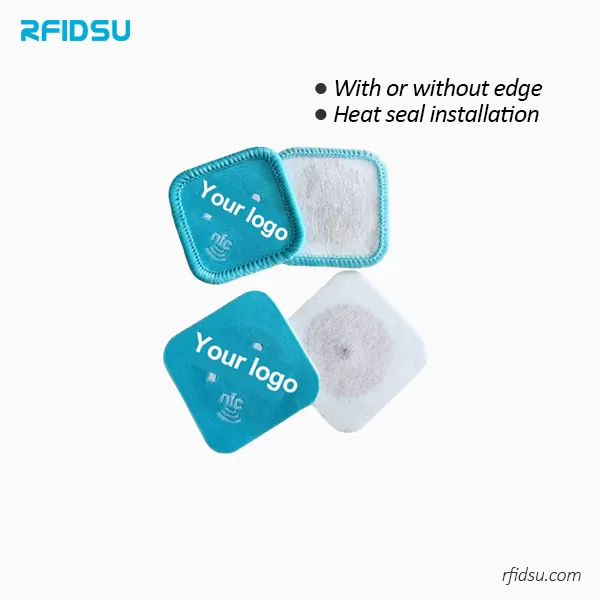
A washable woven NFC tag is a fabric label manufactured using embroidery or jacquard
weaving techniques, with a tiny NFC chip and antenna embedded inside the textile structure. Unlike
printed fabric tags — where the design sits on the surface as ink — the pattern here is physically
woven into the threads. This produces a slightly raised, textured surface with a premium hand feel,
while the embedded chip enables tap-to-read communication with any NFC-enabled smartphone.
At a technical level, a typical woven NFC tag contains four elements:
- The fabric body — woven polyester produced via embroidery or jacquard looms, forming both the visible brand label and the protective casing for the electronics.
- The NFC chip — a passive IC (no battery) that stores a small amount of data: a URL, a serial number, or an NDEF message. Common options include NTAG213, ICODE SLIX, MIFARE Ultralight EV1, and Fudan F08.
- The antenna — a flexible conductive coil woven or laminated into the fabric that powers the chip inductively when a phone comes within 0–5 cm.
- The bonding layer — a heat-activated adhesive or sewn seam channel that keeps the chip and antenna locked inside the textile through repeated washing.
How a tap works in practice
When a consumer holds an NFC-enabled phone within about 5 cm of the label, the phone’s RF field
powers the chip, which transmits its stored data. Depending on what was encoded at the factory,
the tap can open a brand webpage, display an authentication certificate, show care instructions,
or trigger a loyalty reward — all without an app and without line-of-sight scanning.
Unlike QR codes, NFC tags cannot be photographed and reprinted. Each chip carries a
factory-programmed, read-only UID (unique identifier) that cannot be changed or cloned. This
makes woven NFC labels fundamentally harder to counterfeit than any printed authentication mark.
Woven vs. printed fabric NFC tags — the key difference
This is the single most common point of confusion. Both attach to garments and both carry an NFC
chip. The difference is how the visible design is produced:
| Aspect | Woven NFC Tag | Printed Fabric NFC Tag |
|---|---|---|
| How the design is made | Embroidered or jacquard-woven into the threads | Ink applied to the fabric surface |
| Texture | Slightly raised, premium tactile feel | Flat |
| Durability of the design | Will not fade, peel, or crack | May wear with repeated washing |
| Typical use case | High-end apparel, luxury branding, visible neck labels | Cost-sensitive items, hidden care labels |
For brands where the label itself is part of the product’s perceived value — luxury fashion,
premium streetwear, professional uniforms — the woven version is almost always the better fit.
2. Why Brands Are Adopting Woven NFC Tags
The market for NFC-enabled garment labels is not a niche curiosity anymore. According to
Growth Market Reports, the global NFC Smart Label Garment market was valued at
roughly USD 1.50 billion in 2025 and is projected to grow at a CAGR of 18.4% through 2034.
A separate study from Research Intel pegs the broader NFC Apparel Tag market at
USD 1.12 billion in 2024, heading toward USD 4.36 billion by 2033. The adoption curve is real,
and it is being driven by four converging pressures.
Pressure 1: Counterfeiting is a $50 billion problem
The fashion industry loses more than USD 50 billion annually to counterfeit goods, with footwear,
apparel, and leather products accounting for over half of fake imports seized in the EU. Printed
hangtags, holograms, and QR codes can all be reproduced by a competent counterfeiter within days.
A woven NFC label with a factory-locked UID cannot — the chip’s identity is set at the silicon level
and is effectively unclonable. When a customer taps the label and a cloud backend confirms the UID
matches a serialized record, the verification is cryptographic, not visual.
This is why brands like Bulgari have rolled out NFC across their full leather goods line, and why
Nike embedded NFC into NBA Connected Jerseys as far back as 2017. The pattern is now standard among
premium streetwear and limited-drop labels, where each verified tap also doubles as a customer
engagement event.
Pressure 2: Regulation is making digital product passports mandatory
The EU’s Ecodesign for Sustainable Products Regulation (ESPR) will require Digital Product Passports
(DPPs) for textiles entering the EU market — with broad coverage expected by 2030. NFC is one of the
compliant data carriers for this requirement, because a consumer can tap a garment and instantly
access material composition, origin, recyclability, and care data. Brands that wait until the
regulation is fully enforced will be scrambling; brands that embed NFC woven labels now are
building the infrastructure ahead of the deadline.
Pressure 3: Consumers expect a digital experience, not just a product
A woven NFC label turns every garment into a channel. A tap can open styling guides, brand stories,
limited-edition content, warranty registration, or resale authentication. For merchandise and
uniform programs, the same tap can serve access control, membership verification, or event check-in.
The label is no longer a static identifier — it is a bridge between the physical item and whatever
digital experience the brand wants to deliver, updated on the backend without re-tagging the garment.
Pressure 4: Uniform and workwear programs need durable tracking
In commercial laundry and managed uniform programs, the same garment may be washed, sorted, and
reassigned hundreds of times. A woven NFC label that survives 50–100 household wash cycles (and
is engineered for the physical abuse of industrial textile handling) gives operators a stable way
to track garment lifecycle, count wash cycles, and manage inventory without the bulk-scanning
trade-offs of UHF. For consumer-facing programs — hotel robes, corporate apparel, club merchandise —
the same tag also serves as a brand touchpoint.
3. Why Choose RFIDSU’s Washable Woven NFC Tags
Not all woven NFC labels are engineered to the same standard. The difference between a tag that
fails after 20 washes and one that survives 100 is not luck — it is material selection, antenna
design, bonding process, and chip integration. RFIDSU’s
Washable Woven NFC Tags
are built with these factors controlled in-house, and the result shows up in six concrete ways.
1. Real woven craftsmanship — not printed fabric with a chip glued on
The labels are produced using embroidery or jacquard weaving, which means the brand logo and design
are physically integrated into the textile structure. This is the same construction used for premium
woven brand labels in high-end apparel — the NFC electronics are simply embedded inside. The surface
has the slightly raised, textured finish that signals quality, and the design will not fade, peel,
or crack the way printed graphics can.
2. Four chip options covering the full application spectrum
Different use cases need different silicon. RFIDSU supports four chip families, so the tag can be
matched to the actual requirement rather than forcing a one-size-fits-all choice:
| Chip | Protocol | User Memory | Best For |
|---|---|---|---|
| NTAG213 | ISO 14443A (NFC Forum Type 2) | 144 bytes | General consumer NFC, URLs, serial numbers — the most popular choice |
| ICODE SLIX | ISO 15693 (NFC Forum Type 5) | 128 bytes | Longer read range, library and asset-style applications |
| MIFARE Ultralight EV1 | ISO 14443A (NFC Forum Type 2) | 48 bytes | Cost-sensitive entry-level deployments |
| Fudan F08 | ISO 14443A (MIFARE Classic 1K compatible) | 768 bytes (16 sectors) | Access control, encrypted sector-based applications |
3. Wash durability engineered and tested, not just claimed
The tags are rated for 50–100 wash cycles at 50°C under standard household conditions,
with full NFC functionality retained after washing. This is not a theoretical number — it reflects
the double-layer bonding process (single-layer 0.85 mm or double-layer 1.08 mm polyester) that locks
the chip and antenna inside the textile. The tag is also rated for heat-press application at
160–180°C, which means the iron-on installation itself does not damage the electronics.
Important distinction: these tags are engineered for standard household washing
conditions, not industrial high-temperature laundering at 90°C+ with caustic chemicals. If your
application is a commercial laundry tunnel washer, ask about RFIDSU’s industrial-grade UHF
textile tags instead — they are a different product class for a different operating envelope.
4. Dual installation — sew-on or iron-on, no special equipment
The same tag can be attached two ways. Sew-on uses a standard sewing machine to
stitch the label into a seam, neck label, or side seam — the permanent, premium approach used for
branded apparel. Iron-on uses a heat-activated adhesive backing applied with a
desktop heat press or household iron at 160–180°C for 15–20 seconds — faster, and suitable for
merchandise patches or items where stitching is impractical. Brands are not locked into one method.
5. Factory pre-encoding — ship tags ready to deploy
RFIDSU can encode each tag at the factory with your specified URLs, serialized numbers, or custom
NDEF messages before shipping. This means the tags arrive plug-and-play — no in-house encoding
equipment, no batch-management software, no risk of inconsistent writes. For brands running tight
production schedules, pre-encoding is the difference between a label that works the day it arrives
and a label that sits in a queue waiting for someone to program it. Blank (unencoded) tags are
also available for customers who prefer to encode in-house.
6. Full OEM/ODM customization, handled in-house
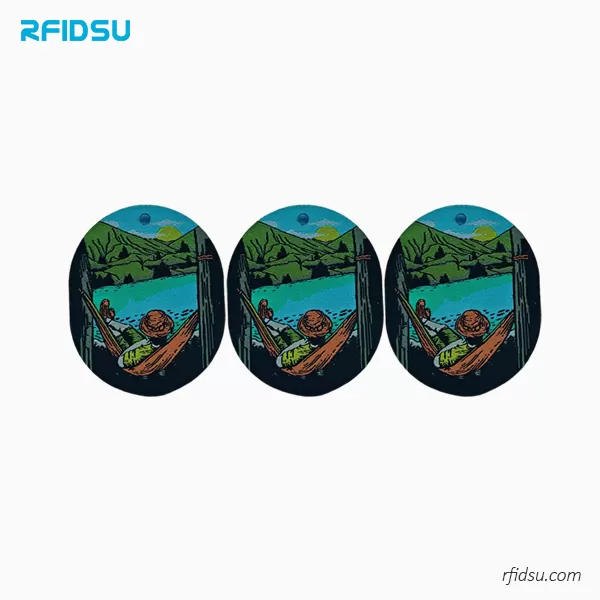
Because RFIDSU is the manufacturer — not a reseller — customization runs the full stack: custom
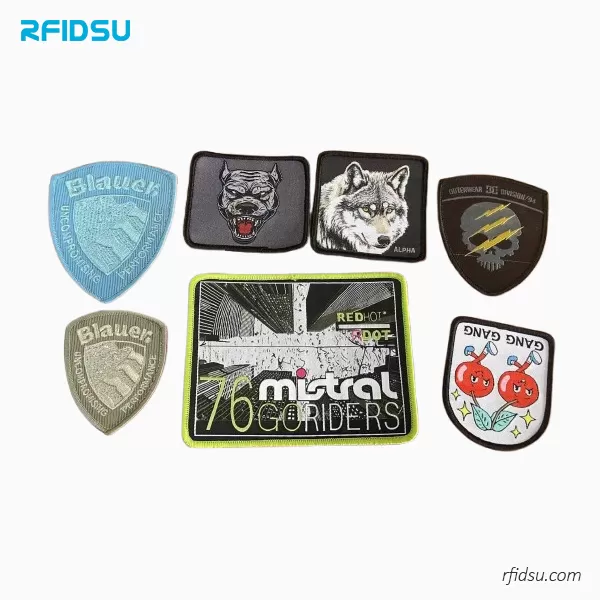
shapes (rectangular, circular, patch, badge-style, or any contour), custom woven logos and patterns,
chip selection, single- or double-layer fabric, custom printing of serial numbers and barcodes,
and custom packaging (individual labeling, barcode-labeled bags, or bulk). Quality is controlled
from antenna design through final delivery, which is why the company serves customers across
multiple countries and offers samples on request.
Evaluating woven NFC tags for your brand?
Explore the full specification sheet, chip options, and customization details on the product page — or request free samples to test wash durability with your own garments.
4. Frequently Asked Questions
Are woven NFC tags the same as RFID laundry tags?
Not exactly. Woven NFC tags operate at 13.56 MHz (HF/NFC) with a short 0–5 cm read range optimized
for one-to-one smartphone interactions — authentication, content delivery, consumer engagement.
Industrial RFID laundry tags typically operate at UHF (860–960 MHz) with read ranges of several
meters, optimized for bulk scanning of hundreds of garments at once in commercial laundry tunnels.
Many apparel programs eventually use both: NFC for the consumer-facing experience, UHF for
back-of-house logistics.
Will the NFC chip still work after the garment is washed?
Yes. Under standard household washing at 50°C, RFIDSU’s woven NFC tags retain full functionality
for 50–100 cycles. The chip and antenna are embedded inside the woven textile with a bonding layer
that protects them from water, detergent, and mechanical agitation. The tags are not designed for
industrial high-temperature laundering.
Can consumers read the tag with a regular phone?
Yes. Any NFC-enabled smartphone (essentially all modern Android devices and iPhone 7 and later)
can read the tag by holding the phone within about 5 cm. No app is required for basic NDEF content
like URLs — the phone’s native NFC handling opens the encoded link directly.
Can the woven design include our brand logo?
Yes — fully. The woven pattern is customizable with brand logos, text, and decorative elements,
produced via embroidery or jacquard weaving. Because the design is woven into the fabric (not
printed), it will not fade or peel over the garment’s life.
What is the minimum order for custom woven NFC tags?
Customization details — including minimum order quantities, lead times, and sampling — are handled
directly with the RFIDSU team. Free samples are available on request so you can test wash durability
and read performance with your own garments and encoding workflow before committing to a production run.
Related reading: Learn more about the full range of
washable woven NFC tags
— including detailed specifications, chip comparisons, and customization options — on the RFIDSU product page.