
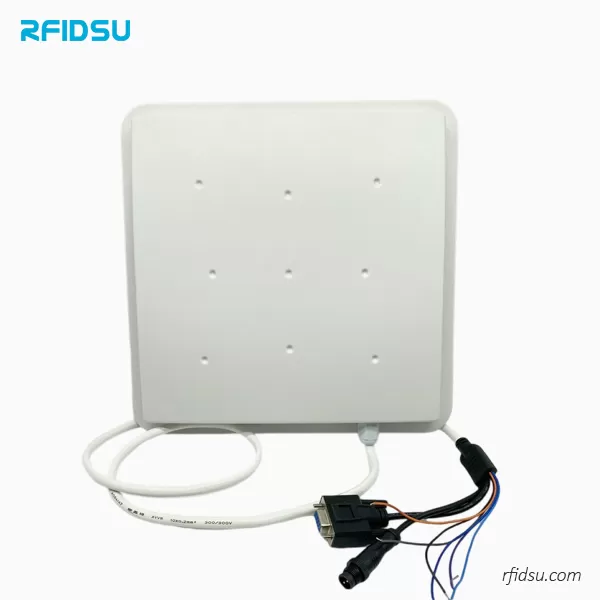
UHF RFID Integrated Reader — fixed-mount for automated conveyor and dock-door scanning
What Are RFID Devices?
An RFID device is any piece of hardware that reads from, writes to, or otherwise interacts with RFID tags and labels. While the tag itself stores the data (a serial number, a product ID, a URL), the device is what captures that data and feeds it into a software system — an inventory dashboard, an access control panel, or a warehouse management platform.
At a functional level, RFID devices fall into four categories:
• Readers / Scanners — capture tag data via radio frequency and pass it to a computer or cloud backend. Fixed readers mount in doorways or conveyor belts; handheld readers let workers scan on the move; USB readers plug directly into a desktop for ad-hoc encoding or verification.
• Printers (with encoding) — print human-readable information onto a label or card while simultaneously encoding the RFID chip embedded inside. This eliminates the separate “print then encode” workflow.
• Encoders / Programmers — dedicated devices for writing data (URLs, NDEF messages, access credentials) onto NFC or RFID tags in batch.
• Antennas — create read zones. Floor-mat antennas, portal antennas, and panel antennas each serve different geometries.
Think of it this way: if RFID tags are the “digital barcode,” RFID devices are the “barcode scanner” — except they can read hundreds of tags simultaneously, from meters away, without line of sight, and they can also write data back.
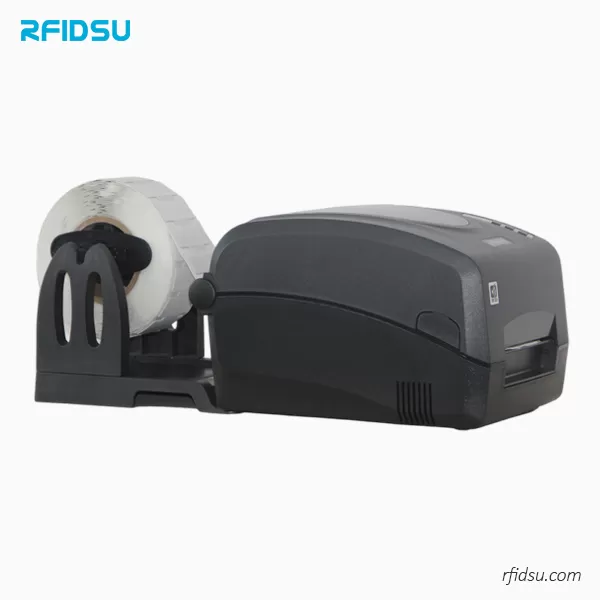
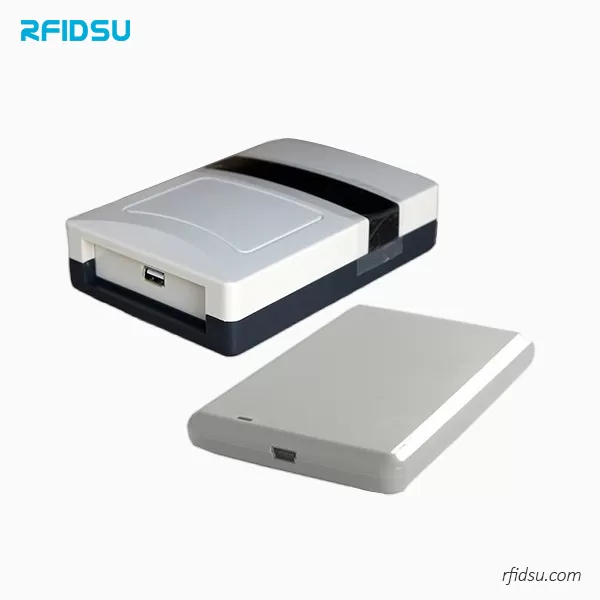
Left: UHF RFID Label Printer — print + encode. Right: UHF USB Reader Writer — desktop programming.
Types of RFID Devices — What Fits Your Operation
The RFID device landscape spans multiple frequency bands (LF, HF/NFC, UHF) and form factors (desktop, handheld, fixed). Here is how each type maps to real-world use:
| UHF RFID Label Printer | 860–960 MHz | Print + encode shipping labels for logistics |
| RFID Card Printer | 13.56 MHz | Print + encode access cards, hotel keys, memberships |
| Wristband Printer | 13.56 MHz / UHF | Print + encode event wristbands, cashless payment |
| USB NFC Encoder | 13.56 MHz | Batch-program NTAG/MIFARE tags with URLs |
| USB RFID Reader | 13.56 MHz | Desktop verification, badge enrollment |
| UHF USB Reader Writer | 860–960 MHz | Desktop UHF programming, inventory spot-checks |
| Mat Floor Antenna | 860–960 MHz | Walk-through inventory scanning — retail, events |
| Integrated Reader | 860–960 MHz | Fixed-mount for conveyors, dock doors, automation |

UHF RFID Mat Floor Antenna — walk-through scanning without manual effort
Why RFID Devices Matter More Than Ever
The global RFID printers and readers market reached USD 6.25 billion in 2025 and is projected to hit USD 13.39 billion by 2032, growing at an 11.5% CAGR (P&W Consulting, 2026). Four structural shifts are driving this:
1. The cost of not knowing is rising. According to the National Retail Federation, inventory inaccuracies reduce retail sales by nearly 4%. RFID devices close the gap between “we think we have 500 units” and “we know we have 500 units” in real time.
2. Tag volumes are exploding. Over 48 billion RFID tags were deployed globally in 2025, and UHF inlay pricing dropped below $0.04. When tags become commodity-cheap, the bottleneck shifts to the device layer — can your printer and reader keep up?
3. Retail, logistics, and healthcare are modernizing simultaneously. Retail accounts for 30.6% of RFID printer/reader deployments. Healthcare RFID improved equipment tracking accuracy by 31%. Logistics RFID integration grew 29% in 2025.
4. Devices are getting smarter. Next-gen readers run lightweight analytics on-device, flag anomalies, and push curated data to WMS dashboards — not just passive data pipes.
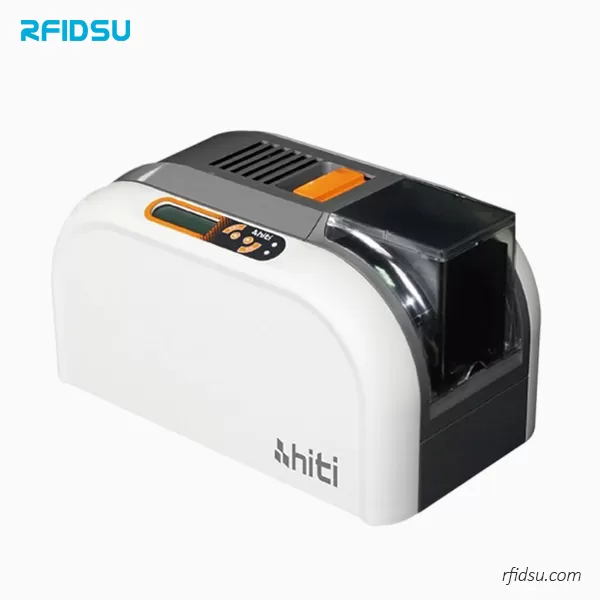
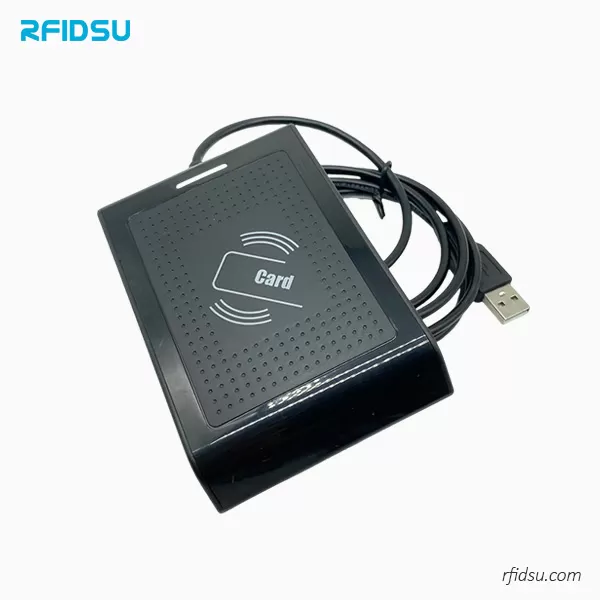
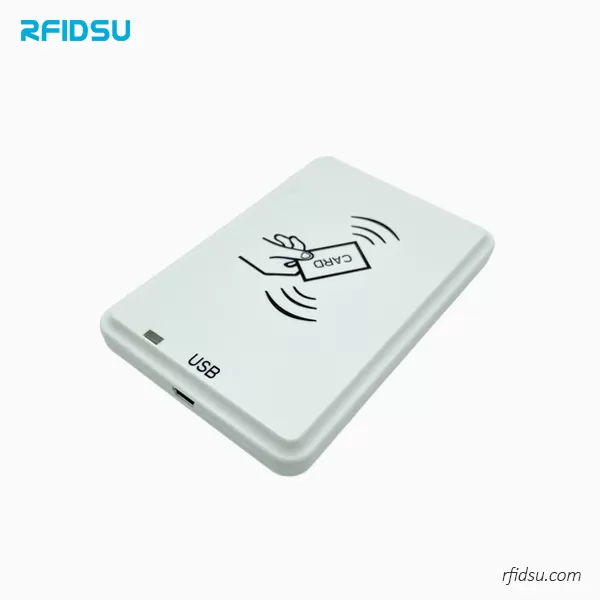
From left: RFID Card Printer, Desktop USB NFC Encoder, 13.56MHz USB RFID Reader
Why Choose RFIDSU’s RFID Device Range
RFIDSU’s RFID devices portfolio covers the full hardware stack — from desktop encoders to industrial fixed readers — with one advantage: every device is sourced and supported by the same team that manufactures your tags. No finger-pointing between tag vendor and device vendor.
One vendor, no compatibility gaps. When you source both tags and devices from RFIDSU, those variables are controlled under one roof. The UHF Label Printer is validated against RFIDSU’s own inlay range; the NFC Encoder is tested with NTAG213, ICODE SLIX, and Fudan F08 tags that RFIDSU supplies.
Full frequency coverage. For access control: 13.56 MHz USB readers, desktop NFC encoders, RFID card printers. For warehouse: UHF integrated readers, UHF USB reader-writers, and UHF label printers with EPC Gen2. For events: direct thermal wristband printers that encode RFID and print simultaneously.
| If your workflow is… | The device you need |
| Printing + encoding UHF labels for warehouse | UHF RFID Label Printer |
| Issuing access cards or hotel keys | RFID Card Printer |
| Producing event wristbands with payment chips | Direct Thermal Wristband Printer |
| Batch-encoding 10,000 NFC tags with URLs | Desktop USB NFC Encoder |
| Verifying tags or enrolling access badges | 13.56MHz USB RFID Reader |
| Fitting-room or checkout-zone scanning | UHF RFID Mat Floor Antenna |
| Automated conveyor or dock-door scanning | UHF RFID Integrated Reader |
| Spot-checking UHF tags on warehouse floor | UHF RFID USB Reader Writer |
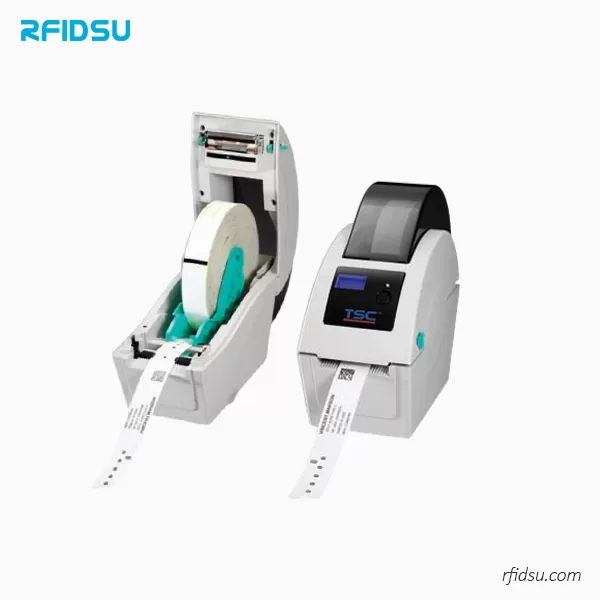
Left: Direct Thermal Wristband Printer. Right: UHF RFID Integrated Reader.
Browse the Full RFID Devices Range →
Related reading: Explore the complete RFID devices, readers, printers and encoders range on the RFIDSU product page for detailed specifications, use-case guides, and OEM sourcing options.