
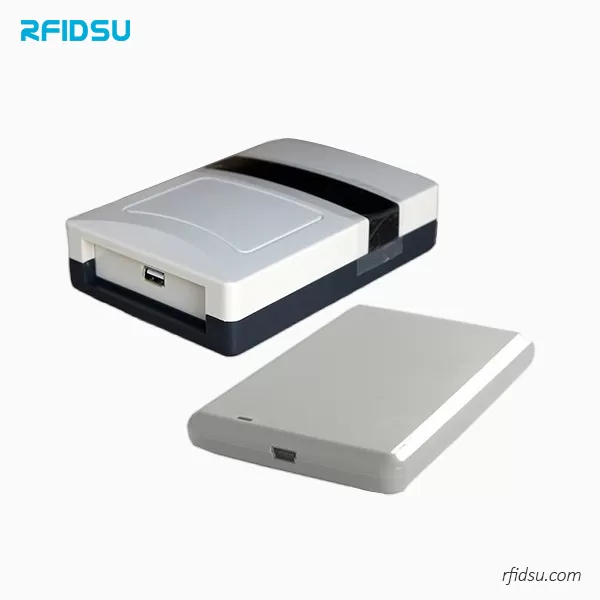
Ask anyone running a warehouse, retail backroom, or logistics hub what their biggest headache is, and you’ll hear the same answer: manual inventory counts. Walking aisle by aisle with a clipboard and barcode scanner, spending hours on a task that still produces errors — it’s the kind of inefficiency that eats margins and frustrates teams. Enter the UHF RFID USB Reader Writer — a desktop device that reads and writes UHF RFID tags at the speed of a USB connection, without needing a bulky handheld terminal or an enterprise deployment.
This guide covers exactly what this device does, how it fits into real-world operations, and why businesses from retail chains to healthcare logistics are adopting USB-based RFID devices as a lightweight alternative to full-scale RFID infrastructure.
What Is a UHF RFID USB Reader Writer?
A UHF RFID USB reader writer is a compact desktop device that connects to any computer via a standard USB port and reads or writes data to UHF (Ultra-High Frequency) RFID tags. Think of it as the RFID equivalent of a USB barcode scanner — but instead of scanning one item at a time at close range, it can read dozens of tagged items simultaneously from up to 30 centimeters away, even through packaging or without line-of-sight.
The device operates in the 860–960 MHz UHF band, the global standard for supply chain and logistics RFID, and supports both ISO18000-6C (EPC Class1 Gen2) and ISO18000-6B protocols. This broad protocol coverage means it can work with virtually any UHF RFID tag on the market, whether it’s a paper label on a retail shirt, a hard tag on a returnable container, or an anti-metal tag bolted to industrial equipment.
The shift from desktop barcode scanners to USB RFID readers represents the same leap as moving from dial-up to broadband — same form factor, dramatically more data per scan.
How It Works — Plug, Read, Write, Repeat
The user experience is deliberately simple: plug the reader into a USB port, and the computer recognizes it as an HID device (like a keyboard) or a COM port (for SDK-driven applications). There’s no driver installation, no network configuration, no middleware server.
- Place a UHF tag on or near the reader surface. The circular-polarization antenna inside ensures reliable reads regardless of tag orientation — no need to align the tag at a specific angle.
- The reader captures the tag’s unique EPC (Electronic Product Code) and data banks. Anti-collision technology handles multiple tags in the field simultaneously — up to 80 tags per second on the higher-powered model.
- Data is sent to the PC via USB. Depending on the model, this can appear as keystrokes in any text field (Keyboard Emulation model), structured records in the included demo software (UHFReader09), or API-level data for custom applications (UHFReader18 with SDK).
- Write operations encode new data onto the tag. Change a product SKU, update a shipment status, or write a new EPC — all from the same desktop device, no separate encoder needed.
Three Models, Three Use Cases
One size doesn’t fit all. The UHF RFID USB Reader Writer series comes in three distinct configurations, each purpose-built for different operational environments:
| Model | Best For | Key Capability | Size |
|---|---|---|---|
| UHFReader09 | Tag encoding & full read-write | Demo software + SDK for custom app development | 105×70×11mm |
| Keyboard Emulation | Quick data entry without software | Reads tags directly into any editable field (Excel, ERP, web forms) | 105×70×11mm |
| UHFReader18 | Longer-range & multi-tag reading | Up to 30dBm output power, 80 tags/sec anti-collision | 160×110×40mm |
Key Features That Set It Apart
🔌 True USB Plug & Play
No external power adapter, no network setup, no driver CDs. Connect the USB cable, and the device draws power and transfers data over the same connection. On the Keyboard Emulation model, the device is recognized as a standard HID input — the same class as a keyboard — which means it works on any operating system (Windows, macOS, Linux, ChromeOS, even thin clients and POS terminals).
📡 860–960 MHz Universal Coverage
Covers the full global UHF RFID frequency range, from FCC (902–928 MHz) used in the Americas, to ETSI (865–868 MHz) used in Europe, to China’s 920–925 MHz band. One device works across continents — no regional SKU variants to manage.
🔄 Dual Protocol: EPC Gen2 + ISO18000-6B
EPC Class1 Gen2 (ISO18000-6C) is the dominant protocol in retail and logistics. ISO18000-6B is older but still found in industrial, toll collection, and some government applications. Supporting both means the reader can handle legacy tags alongside modern inventory labels without switching devices.
⚡ Anti-Collision: Read 80 Tags Simultaneously
When multiple tags are placed on the reader, the anti-collision algorithm separates and identifies each one individually — up to 80 tags per second on the UHFReader18 model. This turns a desktop reader into a small-scale inventory station. Toss a handful of tagged items onto the reader surface, and all EPCs populate in under a second.
⌨️ Keyboard Emulation — Zero Software Required
This is the killer feature for many users. On the Keyboard Emulation model, the reader behaves exactly like a keyboard. Hold a tag near the reader, and the tag’s EPC or data appears wherever your cursor is — an Excel cell, a warehouse management system form, a Notepad window, a web-based ERP field. No SDK. No integration. No IT ticket. For small businesses, branch offices, or anyone who needs RFID data entry without the overhead of custom development, this single feature justifies the purchase.
Real-World Applications
🏬 Retail & Warehouse Inventory
Place the reader at a packing station, receiving dock, or returns counter. Staff can scan incoming shipments, verify outgoing orders, or check returned items against the database — all from a USB-connected laptop. The anti-collision feature means an entire box of tagged items can be scanned at once rather than one at a time.
💻 Tag Encoding & Commissioning
Before deploying RFID tags in the field, someone needs to encode them with the right data. The UHFReader09 model with SDK support lets you write EPCs, user memory, and access passwords to blank tags from your desktop. This is the device that sits on the desk of every RFID deployment engineer — encode a batch, verify they read correctly, ship them out.
📋 Access Control & Attendance
Connect the Keyboard Emulation model to a reception or security desk PC. Employees or visitors tap their RFID badge on the reader. The badge ID appears in the access control log or attendance sheet — no software installation, no configuration. The built-in LED and buzzer provide immediate confirmation that the tag was read successfully.
📚 Library & Document Management
Libraries use UHF RFID for self-checkout kiosks and inventory audits. The USB reader sits at the help desk — librarians can scan returned books, verify checkout status, or encode new tags for incoming acquisitions without needing a full gate-reader system. The adjustable read range (on UHFReader18) prevents accidental reads from books on adjacent desks.
🏥 Healthcare & Lab Specimen Tracking
Hospitals and labs tag blood samples, medication trays, and surgical instruments with UHF RFID. A compact USB reader at the nursing station or lab bench lets staff verify specimen IDs and log movements without touching a shared handheld scanner. The ABS waterproof housing handles the occasional splash or wipe-down.
USB Reader vs. Handheld Terminals vs. Fixed Readers
| Factor | USB Desktop Reader | Handheld Terminal | Fixed Portal Reader |
|---|---|---|---|
| Cost | $20–50 per unit | $500–2,000 per unit | $500–3,000 per lane |
| Setup Time | Seconds (USB plug) | Hours (WiFi + app config) | Days (mounting + cabling + tuning) |
| Software Needs | None (keyboard emulation mode) | Vendor app or custom development | Middleware server + integration |
| Best For | Desk-side encoding, verification, quick inventory counts | Mobile warehouse scanning, field service | Automated dock door scanning, conveyor belts |
The UHF RFID USB Reader Writer occupies the middle ground: it doesn’t replace handheld terminals for mobile workflows, and it doesn’t replace fixed readers for fully automated gates. But for every stationary workstation where someone needs to read or encode tags — which describes most small- to mid-size RFID deployments — it does the job for a fraction of the cost and with zero integration friction.
Industry Context: Why USB RFID Deserves a Spot on Your Desk
The global UHF RFID market is projected to grow from approximately $5.2 billion in 2024 to over $14 billion by 2032 (source: GS1 US / industry reports), driven primarily by retail inventory accuracy mandates (Walmart, Zara, Decathlon), pharmaceutical track-and-trace regulations (DSCSA in the US), and logistics automation. But the vast majority of that growth relies on tags and readers that cost upwards of $500 per unit and require dedicated IT infrastructure.
USB-based desktop readers like the UHFReader09, Keyboard Emulation, and UHFReader18 fill the gap for: small businesses that want RFID benefits without enterprise budgets, branch operations of larger companies that need decentralized tag scanning at remote locations, and developers and integrators who need an affordable test bench device for prototyping before scaling to production.
Technical Specifications at a Glance
| ALL THREE MODELS | |
|---|---|
| Frequency | 860–960 MHz (global UHF band) |
| Protocols | ISO18000-6C (EPC Class1 Gen2) & ISO18000-6B |
| Interface | USB (HID or COM port, model-dependent) |
| Antenna | Built-in circular polarization |
| Material | ABS waterproof housing |
| Indicators | LED + Buzzer for read confirmation |
| Read Range | Up to 300mm (model-dependent, UHFReader18 longest) |
| Anti-Collision | Up to 80 tags/second (UHFReader18) |
Explore more RFID devices for your business, from USB readers to fixed portal readers and handheld terminals.