
Four out of five “my NFC tag stopped working” support tickets share one root cause: the tag was mounted on or near metal. A standard NFC sticker that reads perfectly on a laptop screen will fail within millimeters of a steel cabinet, a machine housing or an aluminum nameplate. The tag is not broken — the physics changed. This guide explains why metal kills ordinary NFC tags, how ferrite-shielded anti-metal NFC tags solve the problem, and how to choose the right chip, form factor and placement for asset tagging on equipment.
1. Why NFC Fails on Metal Surfaces
NFC runs at 13.56 MHz and relies on inductive coupling between the reader’s antenna coil and the tag’s antenna coil. When that loop sits directly against a conductive surface such as steel, stainless steel or aluminum, two things happen:
- Eddy currents: the alternating magnetic field induces circular currents inside the metal. These currents generate an opposing magnetic field that cancels most of the tag’s field before the reader can power the chip.
- Detuning: the metal shifts the antenna’s resonant frequency away from 13.56 MHz, so even the little energy that reaches the chip arrives at the wrong frequency.
The practical result: reading distance on bare metal drops from several centimeters to essentially zero, and the tag may appear completely dead. For a full primer on the technology itself, see our guide to contactless smart card technology.
2. Inside an Anti-Metal Tag: The Ferrite Shielding Layer
An anti-metal (also called on-metal or on-metal-mountable) NFC tag solves both problems with one component: a thin ferrite sheet laminated between the NFC inlay and the adhesive backing. Ferrite has high magnetic permeability but very low electrical conductivity, so it acts as a magnetic “cushion” that completes the antenna’s flux path while blocking eddy currents from forming in the metal below.
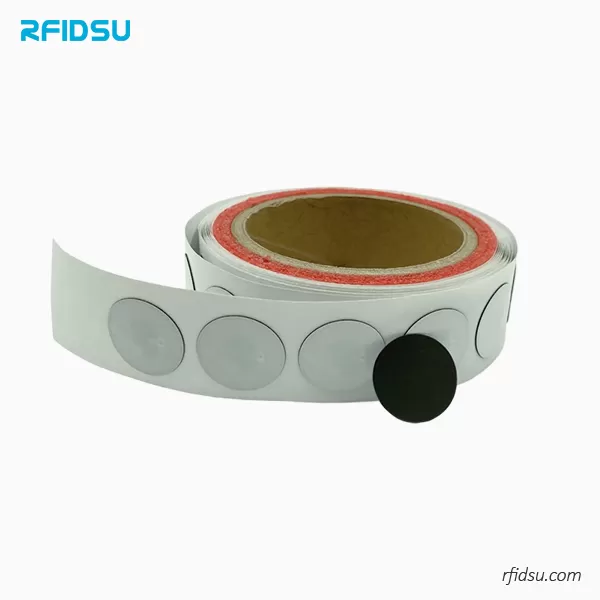
The shielding does more than prevent failure — with a good ferrite layer, a tag on steel can actually outperform the same tag in free air, because the metal acts as a reflector behind the antenna. Typical read ranges on steel: 30–60 mm with a smartphone for a 25–30 mm tag, versus 10–30 mm in free space for the same design.
3. NTAG213 vs NTAG215 vs NTAG216: Which Chip to Order
| Chip | Usable memory | Typical use on metal | Best for |
|---|---|---|---|
| NTAG213 (144 bytes) | 144 B | Single URL or short record | Link-out asset tags, equipment inspection points |
| NTAG215 (504 bytes) | 504 B | URL + JSON records | Tool tracking with metadata |
| NTAG216 (888 bytes) | 888 B | Multiple NDEF records | Rich records, maintenance history pointers |
For pure asset identification on metal, NTAG213 is almost always enough — the ferrite layer, not the chip, determines whether the tag reads. Full chip trade-offs for consumer products are covered in our NFC Google review plate buyer’s guide.
4. Choosing the Form Factor
| Form factor | Thickness | Strengths | Watch out for |
|---|---|---|---|
| Thin on-metal PVC sticker | 0.8–1.2 mm | Low profile, die-cut shapes, prints well, lowest cost | Abrasion on rough surfaces; apply to clean, flat metal |
| Rigid ABS on-metal asset tag | 2–4 mm | Impact resistant, IP67 with epoxy potting, survives outdoor and wash-down | Higher unit cost; needs flat mounting area |
| Anti-metal wet inlay | 0.3–0.5 mm | Laminates inside other materials, most flexible | No printed face unless overlaminated |
| Custom PCB on-metal tag | varies | Unusual shapes, screw or rivet mounting | Tooling cost, longer lead time |

If your application is UHF RFID rather than NFC — for example warehouse pallet or pipeline tracking — the same ferrite principle applies to our UHF RFID on-metal tags, which use foam spacers or ferrite backings tuned for 860–960 MHz.
5. How Much Range Do You Actually Get?
Numbers matter when you specify a tag for a scan point. Measured with a typical smartphone (Samsung/iPhone, no external reader):
- 25 mm anti-metal sticker on steel door: 25–40 mm read, 10–15 mm write
- 30 mm round anti-metal tag on machine housing: 30–60 mm read
- Same tag in free space (no metal): often 10–30% shorter than on steel, thanks to the reflector effect
- Standard (non-anti-metal) sticker on steel: 0–3 mm or no read at all
Write range is always roughly one third of read range, so design your encoding workflow around the smaller figure.
6. Placement Rules That Prevent 90% of Field Failures
- Clean the surface: wipe off oil and powder with isopropyl alcohol before applying; the 3M adhesive needs a clean, flat area.
- Flat side up: the ferrite layer must face the metal, antenna facing out. Installing upside down doubles the failure you were trying to avoid.
- Mind tag-to-tag spacing: keep at least 30 mm between adjacent NFC tags to avoid cross-interference.
- Avoid mounting inside metal pockets: ferrite shielding handles metal behind the tag, not metal surrounding it on all sides.
- Temperature: standard adhesives handle −20 °C to +85 °C; for ovens or freezers specify high-temp adhesive at order time.
7. Seven Real On-Metal Deployments

- Tool crib check-out: NTAG215 anti-metal stickers on pegboard-backed tools; tapping logs who took what.
- IT asset tags on server chassis: thin PVC stickers on steel rack rails and case lids for inventory scans.
- Valve and pipeline inspection: rigid ABS tags on steel valves so field crews tap to open the inspection form.
- Generator and pump maintenance: potted ABS tags survive outdoor weather and let service history follow the machine.
- Kiosk and POS mounting: anti-metal stickers behind steel counter plates for tap-to-pay marketing pages.
- Steel shelving and racks: location tags on rack uprights for cycle counts.
- Outdoor cabinets and telecom sites: IP67 ABS tags with high-temp adhesive for site ID and access logging.
8. Common Failure Modes and How to Avoid Them
- Bought a regular sticker by mistake: no ferrite layer = dead on metal. Always confirm “anti-metal” or “on-metal” in the spec sheet.
- Tag applied over paint thicker than 2 mm: paint is fine, but thick non-metallic coatings add gap distance and reduce range. Clean down to bare metal or accept ~20% range loss.
- Scanning app in the wrong mode: iOS background tag reading only triggers on NDEF-formatted tags. If your tag is blank, encode it first — see our guide on programming NFC tags on iPhone.
- Adhesive failure, not RF failure: tags peeled off by vibration are the most common “tag stopped working” report. For vibrating equipment, specify epoxy-potted ABS housings.
9. FAQ
Can I just add a spacer between a normal NFC tag and the metal?
Partially. Air or foam of 3–5 mm restores some function, which is how many UHF foam-mount tags work — but at NFC’s 13.56 MHz the tag becomes bulky and still underperforms a real ferrite sheet. For NFC, ferrite shielding is the correct engineering answer.
Do anti-metal NFC tags cost much more?
Typically 30–60% more than a standard sticker of the same size, dominated by the ferrite laminate. In project terms this is usually trivial compared with the cost of a failed deployment and rework.
Will anti-metal tags work on non-metal surfaces?
Yes. On plastic, wood or glass they behave like a normal NFC tag — the ferrite layer does not hurt performance on non-conductive surfaces.
What is the smallest on-metal NFC tag available?
Production ferrite-backed tags go down to roughly 12–15 mm diameter with usable smartphone read range of 5–15 mm. Below that, coupling is too weak for reliable phone reads.
Can I print my logo on anti-metal tags?
Yes — PVC on-metal stickers accept full-color digital print, and ABS asset tags support laser marking and epoxy dome logos. Send artwork for a free print proof before ordering.
Are these tags compatible with iPhone and Android?
Yes. NTAG213/215/216 chips are NDEF-compliant and work with iPhone 7 and later background reading, plus all modern Android NFC phones.
10. References & Further Reading
- NXP NTAG213/215/216 datasheet (PDF) — memory maps and antenna guidance
- NFC Forum — NDEF specification and tag operation standards
- NFC Google Review Plate Buyer’s Guide — chip and housing selection for consumer-facing tags
- How to Program NFC Tags on iPhone — encoding and locking workflow
Get Anti-Metal Samples Before You Roll Out
RFIDSU manufactures ferrite-shielded NFC tags in thin PVC, rigid ABS and custom PCB form factors, with NTAG213/215/216 chips, full-color printing and encoding. We ship free samples with no MOQ — test on your actual metal surface before committing. Request anti-metal NFC samples.